
How can online Learning drive continuous improvement and operational performance?

Online learning now generates more data than ever, giving L&D teams unprecedented visibility into what employees learn.
But one critical question remains: what happens after the course? How does newly acquired knowledge translate into better decisions, new behaviours, and measurable performance on the job?
L&D is facing the challenge of proving its impact
Learning is not short on data. Today’s platforms track more than ever: completion rates, learner satisfaction, time spent, assessment scores, knowledge retention, proficiency levels, and even individual progress.
Yet most of these metrics remain confined to the learning environment. They tell us whether someone completed a course, understood the content, retained key information, or passed an assessment. They reveal far less about what happens next—when that learner must apply their knowledge in a complex, fast-changing, and constrained work environment.
The 2025 EdTech France Barometer reflects this shift. L&D leaders still rely heavily on positive learner feedback to evaluate instructional quality, but they increasingly view the successful application of new skills at work as a key measure of success. The same report found that 42% of training managers expect a greater focus on practical skills application in 2025–2026.
For employees, the question is different. It is no longer simply, “Did I learn something?” but “Am I getting better at my job?” A learning experience can be useful, clear, engaging, and rigorously assessed without making employees feel more capable in
Why mastering a training doesn't always mean progressing on the job
Effective online learning is about far more than delivering content. It creates a structured learning journey, strengthens retention, checks understanding, assesses mastery, and supports continuous development.
However, mastery is usually measured in a controlled learning environment. Assessments can confirm that learners have acquired knowledge, but they rarely replicate the complexity of real work.
On the job, employees face incomplete information, competing priorities, time pressure, interpersonal dynamics, and emotionally charged situations. They must interpret context, make trade-offs, adapt their behavior, and respond to the unexpected.
This is where learning transfer often breaks down.
This disconnect is known as the Learning gap: the gap between knowing what to do and being able to apply that knowledge effectively in a real situation. Cognitive science points to several evidence-based principles that can help bridge it:
- Retrieval practice strengthens learning by requiring learners to actively recall information rather than simply review it.
- Spaced practice improves long-term retention by distributing learning over time instead of concentrating it into a single session.
- Interleaving supports transfer by exposing learners to different types of situations and requiring them to select the right approach for each one.
- Feedback turns experience into learning by helping employees understand what worked, what did not, and what to adjust next time.

Good to know
Research by Ericsson, Krampe, and Tesch-Römer adds another perspective: performance does not automatically improve with experience or repetition. It improves through deliberate practice: a structured, demanding activity focused on improving specific areas, with feedback and gradual correction.
For L&D teams, the implication is clear: passing an assessment is not the end of learning. It signals that the learner is ready for the next, more demanding stage—applying their knowledge on the job.
Assessed mastery is a milestone, not the finish line. Skills become stronger and more transferable when employees apply them in varied situations, receive targeted feedback, adjust their approach, and try again.
Training alone isn’t enough: why deliberate practice matters
The challenge is not simply providing access to training. It is closing the gap between demonstrated mastery and effective application in the flow of work.
This is why simulations, role-plays, and AI coaching are becoming increasingly important, shifting the focus of learning from content consumption to active practice.
But adding a few exercises—or a one-off simulation at the end of a course—is not enough. To create lasting change, practice must be designed as a structured progression system. Practice improves performance only when learners are challenged, supported, and given repeated opportunities to refine their approach.
In Ericsson’s research, deliberate practice is fundamentally different from simple repetition. It focuses on a specific performance gap, requires sustained effort, provides meaningful feedback, and enables learners to make gradual, targeted improvements.
For L&D teams, this means designing practice around several essential principles:
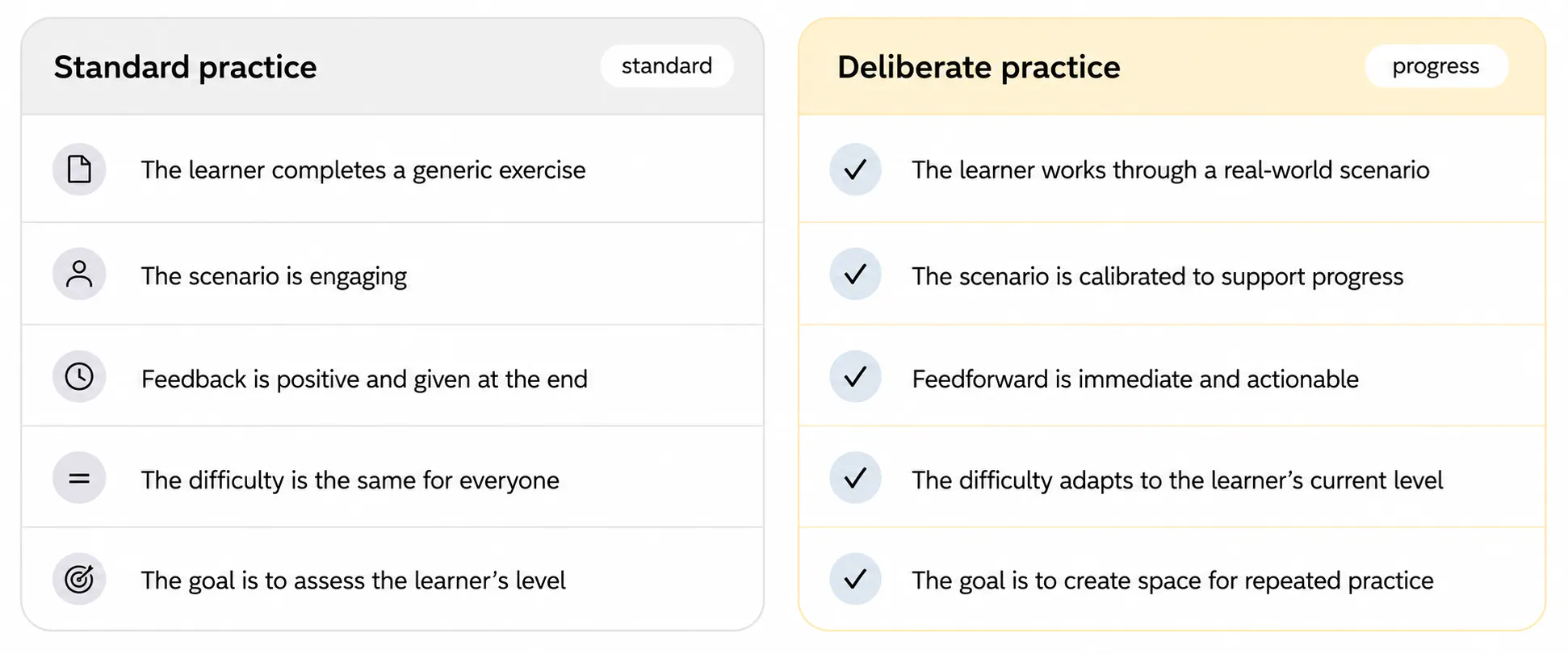
Simulations bring learning closer to reality without immediately exposing the learner to real-world risks, and each modality has a different role:
- Role-plays train behavioral skills: handling objections, giving feedback, holding interviews, managing conflict, or responding to a customer.
- AI coaching can provide individualized, immediate, and repeatable feedback.
- Adaptive learning adjusts the challenge to each learner’s actual level.
The real issue isn't the tool, but the loop: learning, practicing, applying, receiving feedback, and trying again.
This loop moves the learner from assessed mastery to deployable skill. It creates the conditions for transfer by gradually bringing the learner closer to real work situations.
The other key challenge: making progress visible
Learning is not enough: employees need to see their progress, and the organization needs to see what is changing. Making that progress visible should be a strategic priority for L&D.
For employees, visible progress builds motivation, confidence, and a sense of forward momentum. Long-term engagement comes not from completing another programme or earning a higher score, but from recognizing that they are becoming more capable—making better decisions, navigating difficult situations, gaining autonomy, reducing errors, and performing their role with greater confidence.
For managers, visibility creates opportunities for more effective coaching. They can identify changes in behavior, uncover remaining capability gaps, create opportunities for on-the-job application, and provide more targeted feedback.
For L&D leaders, it means looking beyond activity metrics. The question is no longer simply, “Who completed the training?” but “What can employees now do better than before?”
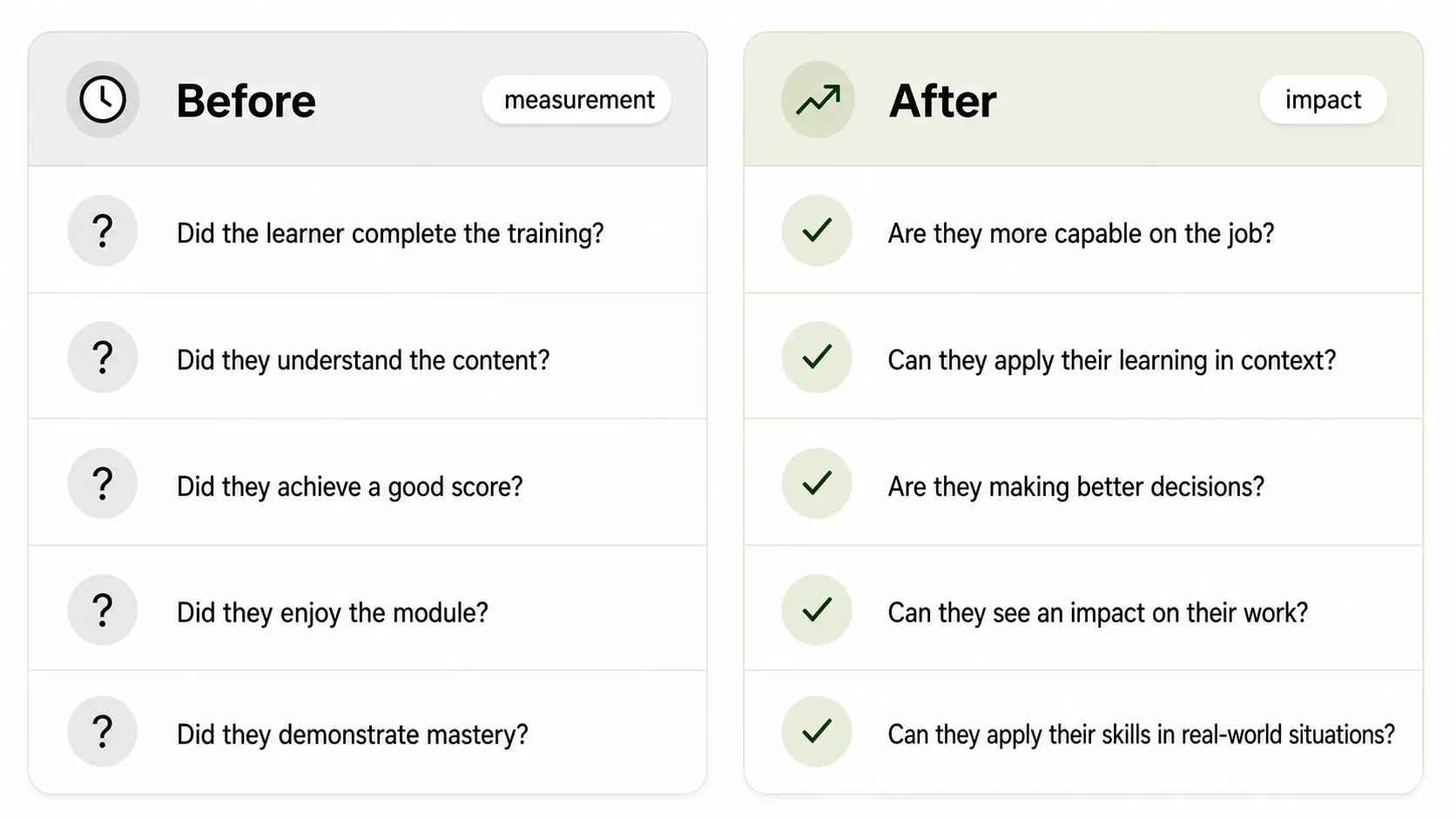
L&D must therefore shift from measuring learning activity to measuring meaningful change: observable behaviors, better decisions, greater autonomy, increased confidence, and improved performance.
L&D’s evolving role: from delivering training to enabling performance
L&D professionals have an unprecedented opportunity to play a central role in organizational transformation by closing the gap between learning and doing. Their role is no longer limited to designing and delivering training; it is about enabling performance. That means giving employees the knowledge, practice opportunities, feedback, and guidance they need to succeed at work.
This is precisely the ambition of Adaptive Training: bringing content, knowledge retention, practice, feedback, adaptation, and measurement together in one continuous development experience:
- Content structures knowledge.
- Retention strengthens memory.
- Assessment measures mastery.
- Practice enables application.
- Feedback supports improvement.
- Adaptation adjusts the level of effort and challenge.
- Measurement makes progress visible.
The focus is no longer simply on completed training—or even validated mastery—but on skills that have been practised and are ready to use.
This evolution addresses today’s dual imperative: demonstrating that L&D makes a measurable contribution to performance, while showing employees how learning helps them make tangible progress in their work.