
How to choose an LMS in 2026: the essential criteria
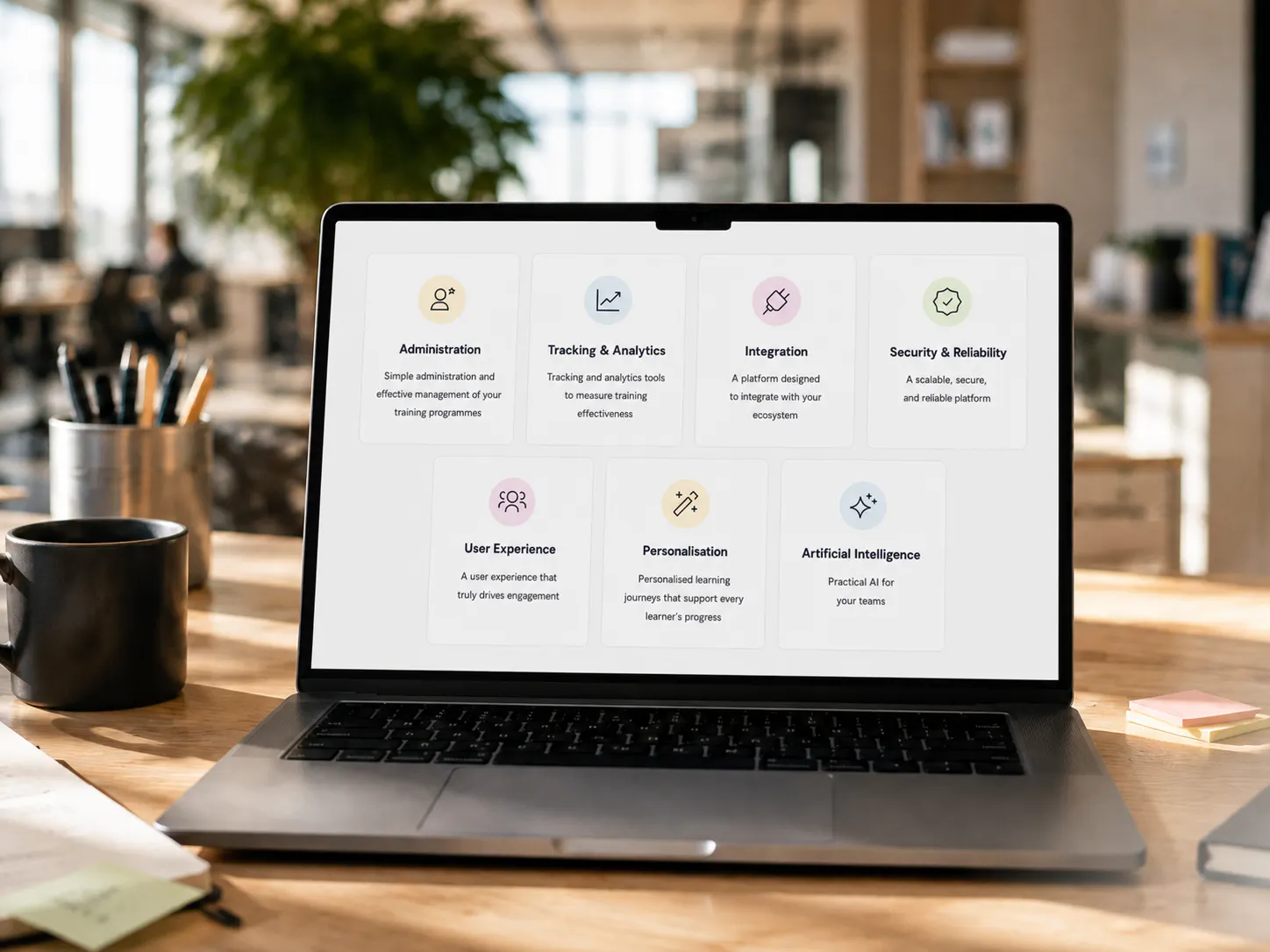
Choosing an LMS (Learning Management System) has become a strategic decision for organizations looking to structure and scale their digital learning strategy. This guide explores the essential criteria for selecting an LMS that meets your needs in 2026.
An LMS—also known as learning management software—enables organizations to centralize learning content, create and deliver online training, manage learning journeys, track learner progress, and use data to monitor and improve their programmes.
For many years, the primary role of an LMS was administrative: enrolling learners, managing users, tracking course completion, and maintaining reliable training records. These capabilities remain essential. An LMS is still the foundation of an effective digital learning ecosystem, particularly for organizations that support large learner populations, manage mandatory training, or deliver programmes at scale.
However, organizational expectations have changed significantly. Roles are evolving rapidly, skills must be developed continuously, and employees now expect learning experiences to be as simple and intuitive as the digital tools they use every day.
Choosing an LMS is therefore no longer a matter of comparing feature lists. Organizations need platforms that can simplify learning administration, improve the learner experience, personalize development journeys, turn learning data into actionable insight, and support emerging use cases powered by artificial intelligence.
This guide will help you evaluate the seven most important selection criteria and identify the LMS best suited to your organization, your L&D team, and your learners.mplifier la gestion de la formation, d'améliorer l'expérience des apprenants, de personnaliser les parcours d'apprentissage, d'exploiter les données de formation et d'intégrer de nouveaux usages liés à l'intelligence artificielle.
Ce guide vous aidera à comparer les principaux critères de choix afin d'identifier le logiciel LMS le plus adapté à votre organisation, à vos équipes formation et à vos apprenants.
Why choosing the right LMS is more strategic than ever in 2026
For many years, choosing an LMS largely meant comparing administrative features: user management, course delivery, learning journey tracking, and reporting.
These capabilities remain essential. They form the foundation of any LMS and enable L&D teams to deliver learning programmes efficiently and at scale. But they are no longer enough to differentiate the platforms available on the market.
Organizations now operate in an environment where skills must be developed continuously, roles are evolving rapidly, and employees expect learning experiences to be as intuitive as the digital tools they use every day. At the same time, artificial intelligence is creating new opportunities to produce content, personalize learning journeys, and turn learning data into more actionable insight.
The role of the LMS is therefore expanding. Beyond administration, it must simplify the work of L&D teams, deliver a seamless learner experience, and integrate naturally with the organization’s wider technology ecosystem.
This evolution is precisely what makes choosing an LMS more strategic than ever.
Two platforms may offer similar features on paper yet deliver radically different experiences once implemented. The real difference no longer lies solely in the number of available features, but in the platform’s ability to support your organization’s current needs and evolve with its future priorities.
Selection criteria must therefore extend beyond traditional functionality. In 2026, organizations need to evaluate the platform as a whole: its administration, user experience, integration capabilities, scalability, data and analytics, security, and practical use of artificial intelligence.
The 7 essential criteria for choosing an LMS in 2026
The right choice depends on your organization’s context, objectives, and learning strategy. A company primarily managing regulatory training will not have the same requirements as an international organization supporting thousands of learners across multiple countries.
Nevertheless, seven criteria deserve particular attention. They will help you look beyond sales demonstrations and evaluate whether a platform can genuinely support your needs—both today and in the future.
1. Simple administration and effective Learning Management
Before evaluating the user experience or artificial intelligence capabilities, make sure the LMS performs its primary function well: managing your learning programmes efficiently.
This is often where the success of an LMS project is determined. A platform may look impressive, but if day-to-day administration is complicated, it will create unnecessary work for your L&D team.
When comparing platforms, examine how they work in practice:
- How are users created, organized, and managed?
- Is it easy to structure a learning catalogue?
- Can enrolment be automated?
- Can learning journeys be assigned according to role, business unit, location, level of responsibility, or employee group?
A good LMS should also support multiple learning formats. Whether you deliver e-learning, classroom sessions, virtual classes, or blended learning programmes, everything should be manageable from a single platform that provides a consolidated view of learning activity.
Automation is another significant source of productivity. Some platforms can automatically send invitations, reminders, notifications, and completion certificates. Others simplify mandatory training renewals or automatically enrol new employees based on their profile.
These capabilities become increasingly important as your organization grows. Effective administration saves time, reduces errors, and creates a smoother experience for learners and administrators alike.
During demonstrations, ask vendors to show you how users, groups, catalogues, and learning journeys are managed. Your L&D team will perform these tasks every day, so they will have a far greater impact on long-term satisfaction than impressive features that are rarely used.
The essential question is simple: Will this LMS genuinely simplify the day-to-day management of learning?
2. Tracking and Analytics that measure Learning effectiveness
When selecting an LMS, organizations often focus on its ability to deliver training. Once the platform has been implemented, however, another question quickly becomes central: how can you measure the effectiveness of your learning programmes?
This is the role of analytics and dashboards. Almost every LMS now provides reporting features, but the level of insight they offer varies considerably.
Standard metrics typically include:
- enrolment numbers;
- completion rates;
- assessment results;
- time spent learning;
- certifications achieved.
These metrics remain essential for managing mandatory training and monitoring participation. But a strong LMS should go further.
L&D leaders increasingly need to understand how programmes are actually being used:
- Which learning journeys are completed?
- Which content attracts the most attention?
- Where do learners disengage?
- Which modules generate the strongest results?
- Which employee groups require additional support?
These insights help teams identify content that needs improvement, learner populations that require intervention, and journeys that should be redesigned.
Reporting quality also depends on how clearly and flexibly data is presented. During demonstrations, check whether dashboards can be adapted to different user profiles. An LMS administrator, line manager, HR leader, and senior executive will not need the same information.
The ability to create tailored reports, export data, schedule reports, and automatically share selected indicators can save significant time.
If your organization needs to track learning beyond the LMS, check whether the platform supports standards such as xAPI. This makes it possible to collect learning data from multiple environments and build a more complete view of employee development.
Ultimately, a good dashboard should do more than produce statistics. It should help L&D teams make better decisions and continuously improve their programmes.
3. Integration with your technology ecosystem
An LMS rarely operates in isolation. It must work within an ecosystem that may include an HRIS, talent or skills management software, collaboration tools, videoconferencing platforms, CRM systems, and business applications.
The more effectively these systems communicate, the simpler and more reliable learning administration becomes.
An isolated platform often forces teams to re-enter information, import files manually, and perform repetitive administrative tasks. When comparing solutions, evaluate the LMS’s ability to integrate with your existing technology environment.
Compatibility with digital learning standards is a useful starting point. Does the platform support SCORM, xAPI, or AICC content? These standards make it easier to import and deliver learning resources created with different authoring tools.
You should also examine integration with your HRIS. Automatically synchronizing users, departments, roles, and organizational structures reduces administrative work and improves data reliability.
Single Sign-On (SSO) is another important criterion. It allows employees to access the LMS using their existing company credentials without creating another account. Removing this point of friction can significantly improve platform adoption.
Finally, assess the vendor’s APIs. A comprehensive and well-documented API will make it easier to exchange data with existing tools and evolve your digital ecosystem over time.
A good LMS should not become another isolated system to manage. It should integrate naturally into your technology landscape and make life easier for both learners and administrators.
4. Scalability, security, and reliability
Choosing an LMS is usually a long-term commitment. Learning platforms are rarely replaced after only a few months; they often support an organization for several years and must evolve alongside it.
Your organization may have a few hundred employees today, but what will it look like in three or five years?
Consider whether the LMS can:
- support new departments, subsidiaries, and countries;
- manage several thousand learners;
- accommodate different roles and permission levels;
- support multiple learning catalogues;
- operate in multiple languages;
- maintain reliable performance as usage grows.
Pricing scalability also matters. Will the commercial model remain sustainable as your workforce expands, or will costs rise sharply as you add users and functionality?
Security is equally critical. An LMS stores sensitive information, including employee data, learning histories, assessment results, certifications, and internal learning resources.
Before making a decision, evaluate the vendor’s commitments regarding:
- GDPR compliance;
- data location and hosting;
- service availability and uptime;
- backups and disaster recovery;
- data encryption;
- access and permission management.
International organizations and companies operating in highly regulated sectors should also examine recognized security certifications, such as ISO 27001, as well as data portability and reversibility provisions if they later decide to change platforms.
A reliable LMS is one your organization can depend on over the long term—without compromising data security or the quality of the learning experience.
5. A User Experience that genuinely drives engagement
An LMS may offer an excellent range of features on paper. But if employees find it difficult to use, its impact will remain limited.
User experience is now one of the most important drivers of LMS adoption. Employees are accustomed to intuitive digital applications and bring the same expectations to workplace learning. They want to find relevant content quickly, resume a learning journey where they left off, and navigate easily from a computer, tablet, or smartphone.
LMS usability is therefore about more than visual design. It includes the entire learner journey:
- clear and intuitive navigation;
- effective search;
- fast access to resources;
- readable information;
- a consistent mobile experience;
- minimal friction between login and learning.
During vendor demonstrations, do not simply watch a polished presentation. Ask to perform realistic tasks:
- How easy is it to find a course in the catalogue?
- How many clicks are required to launch a module?
- Can learners automatically resume an interrupted journey?
- Is the mobile experience genuinely comparable?
These details may appear minor, but they directly influence learner engagement and course completion.
Some platforms also include features designed to support engagement, such as notifications, automated reminders, content recommendations, certification journeys, badges, and progress dashboards.
The objective is not to add gamification for its own sake. It is to make learning easier, more relevant, and more motivating.
A good LMS ultimately becomes almost invisible: employees focus on learning rather than on figuring out how to use the platform.
6. Personalized journeys that support every Learner’s progress
Different employees have different learning needs. A manager, salesperson, technician, and new starter will not require the same content or development journey. Yet some platforms still provide an identical experience to every user.
Personalization has become a meaningful differentiator. The objective is not necessarily to build a completely unique programme for every employee. It is to deliver the right learning to the right people at the right time.
Depending on the platform, personalization may be based on:
- role or profession;
- business function;
- language;
- location;
- seniority;
- previously acquired knowledge or skills.
An LMS may automatically recommend relevant content, adapt learning journeys according to learner profiles, or highlight programmes that match an employee’s context.
This approach offers two benefits. Employees encounter less irrelevant content and receive a more focused learning experience. Meanwhile, L&D teams can deliver more targeted programmes without manually creating a completely separate journey for every population.
When comparing platforms, also consider how easy these features are to administer. Advanced personalization will create little value if configuring it is too complex. A platform that makes it easy to create assignment rules, audience segments, and conditional pathways is far more likely to be used effectively.
Personalization should not be dismissed as a marketing feature. It is an important way to make learning more relevant, efficient, and engaging.
7. Artificial Intelligence that delivers practical value
It is now almost impossible to compare LMS platforms without considering artificial intelligence. In only a few years, AI has become an important selection criterion alongside administration, reporting, and integrations.
However, platforms do not all use AI in the same way. Some primarily use it to accelerate learning content creation, with features such as:
- quiz generation
- scenario suggestions
- automated summaries
- first drafts of learning modules
Others use AI to improve the learner experience through personalized recommendations, conversational search, or easier access to relevant learning resources.
AI can also support L&D teams by automating administrative work, simplifying learning data analysis, and highlighting trends that would be difficult to identify manually.
Given the variety of possible applications, it is important to look beyond the label. The right question is not: “Does this LMS include artificial intelligence?”
It is: “How will these capabilities improve the way we create, deliver, administer, and evaluate learning?”
During demonstrations, ask vendors which AI capabilities are available today and which remain on the product roadmap. You should also ask about:
- data confidentiality
- the AI models being used
- whether your data is used to train those models
- how the platform can work with your proprietary learning content
- the level of control retained by administrators
- how AI-generated outputs can be reviewed and validated
Artificial intelligence will not replace a coherent learning strategy. But when thoughtfully integrated into an LMS, it can save time, improve the learner experience, and help L&D teams deliver greater value every day.
How to compare LMS platforms based on your organization’s needs
Once you have identified your essential criteria, one question remains: how do you choose between several apparently similar platforms?
On paper, many LMS solutions provide comparable capabilities, including user management, learning catalogues, reporting, integrations, and personalized journeys. Yet two platforms with similar feature lists can deliver very different experiences once implemented.
There is no single LMS that is best for every organization. A solution designed for a large multinational may not suit an SME beginning its digital learning journey or a mid-sized company formalizing its learning strategy.
The objective is not to find the LMS with the longest feature list. It is to select the platform that best addresses your current priorities while remaining capable of supporting your organization’s future development.
The following steps can help you compare solutions systematically and make a more informed decision.
Begin by defining your objectives
Many organizations begin by comparing the platforms available on the market. In reality, that stage often comes too early.
Before requesting demonstrations or examining individual features, clarify what the LMS project needs to achieve.
Are you looking to:
- digitize existing training?
- centralize your learning catalogue?
- simplify programme administration?
- track skills development more effectively?
- produce more reliable reports?
- improve ease of use and learner engagement?
Your answers will directly shape your selection criteria.
An organization seeking to standardize and scale learning management will naturally prioritize administrative capabilities, automation, HRIS integrations, and reporting. By contrast, a company aiming to encourage greater learner autonomy may place more emphasis on user experience, personalized journeys, content discovery, and artificial intelligence.
Defining your objectives at the outset gives you a meaningful evaluation framework. It also reduces the risk of being persuaded by the most impressive demonstration rather than the most suitable platform.
Evaluate your current and future requirements
Organizations begin LMS projects at very different levels of maturity.
Some already have an established L&D team, an extensive learning catalogue, clearly defined governance, and several thousand learners. Others are only beginning to digitize their programmes and primarily need a platform that is easy to understand, quick to implement, and simple to administer.
This level of maturity should influence your choice.
A feature-rich LMS may be a powerful asset for an experienced organization. But if your team lacks the time, resources, or expertise to use its advanced capabilities, much of that functionality will remain unused.
Conversely, a platform that is too limited may quickly become a constraint as adoption grows, new audiences are added, and your requirements become more sophisticated.
Consider where your organization may be in three to five years:
- Is significant workforce growth expected?
- Will new roles or business units emerge?
- Are you planning international expansion?
- Will digital learning become a more important part of your strategy?
- Will you need to support additional languages, audiences, or learning formats?
Choosing an LMS also means selecting a platform capable of growing alongside your organization.
Account for your operational and technology constraints
Choosing an LMS is not solely a learning decision. The platform must also meet the needs of HR, IT, managers, administrators, and—most importantly—the employees who will use it.
Involving these stakeholders early in the project helps uncover requirements and constraints that may not be apparent during a standard sales demonstration.
Different groups will naturally focus on different priorities:
- IT teams will examine security, hosting, SSO, APIs, data architecture, and systems integration.
- HR teams will focus on skills tracking, reporting, employee data, and audience management.
- Managers will need easy access to relevant information about their teams.
- LMS administrators will prioritize efficient workflows, automation, and ease of configuration.
- Learners will expect a platform that is fast, intuitive, accessible, and easy to navigate.
Addressing these expectations early makes implementation smoother and improves the likelihood of long-term adoption.
A learning platform never operates in isolation. The more naturally it fits into your technology and organizational environment, the more value it will deliver.
Compare overall value, not just price
Price is naturally an important consideration when choosing an LMS. But comparing platforms solely on subscription cost can be misleading.
Two solutions with similar pricing may provide very different levels of service, including:
- implementation support
- customer service quality and availability
- update frequency
- documentation and training resources
- change-management support
- configuration and personalization options
You should also evaluate the project’s total cost of ownership.
How long will implementation take? Will administrators require specialist training? Are future updates and new functionality included in the subscription? What level of support is available when problems arise? Will integrations, data migration, or configuration involve additional costs?
All these factors influence the real cost of the project.
Finally, consider the vendor’s product vision:
- How frequently does the platform evolve?
- Does its roadmap reflect changes in the L&D market?
- How does the vendor approach innovation?
- What practical role does artificial intelligence play in the product?
- Can the vendor demonstrate a credible long-term strategy?
Choosing an LMS is ultimately about more than purchasing software. It means selecting a partner that will support your learning strategy for several years.
Choosing an LMS in 2026 is an investment in your Learning strategy
Choosing an LMS is no longer simply about selecting a platform that can deliver training.
The fundamentals remain essential: managing learning journeys efficiently, administering users, producing reliable reports, supporting regulatory compliance, and integrating seamlessly with the organization’s technology ecosystem. But these capabilities alone are no longer enough to differentiate one solution from another.
Expectations have changed. Employees want learning experiences that are simpler, more relevant, and more personalized. L&D teams need better data to manage and improve their programmes. Meanwhile, artificial intelligence is creating new opportunities to design learning experiences, support learners, and reduce the administrative workload.
The best LMS is therefore not the platform with the longest feature list. It is the one that best reflects your objectives, organizational maturity, technology environment, and the learning experiences you want to develop over the coming years.
Before comparing platforms, take the time to define the role you genuinely want your LMS to play. A learning platform is more than a piece of software: it is a long-term investment in your organization’s learning strategy and workforce capabilities.
FAQ : all you need to know before choosing an LMS
What is an LMS?
An LMS (Learning Management System) is software used to manage learning activities, including content delivery, learner enrolment, learning journey tracking, assessments, and reporting. It centralizes learning administration and delivery within a single platform.
What Is the difference between an LMS and an LCMS?
An LMS is primarily designed to manage and deliver learning programmes. An LCMS (Learning Content Management System) also includes tools for creating, managing, and updating learning content. Some solutions, such as Teach Up, now combine both capabilities within a single platform.
Is an LMS suitable for an SME?
Yes. LMS platforms can support SMEs as well as large enterprises. The key is to choose a solution that reflects your organization’s size, objectives, resources, and level of learning maturity. Some platforms are specifically designed to scale as the company grows and its requirements evolve.
How much does an LMS cost?
The cost of an LMS depends on factors such as the number of users, available functionality, implementation support, and required integrations.
In addition to licence or subscription fees, consider the project’s total cost of ownership, including implementation, data migration, administrator training, customer support, integrations, and future platform development.
Can an LMS manage in-person training?
Yes. Most LMS platforms can manage online learning, classroom-based sessions, virtual classes, and blended learning journeys. These different formats can be scheduled, administered, and tracked from a single platform.
Which content formats can an LMS deliver?
An LMS will generally support established digital learning standards such as SCORM and xAPI. Depending on the platform, it may also deliver videos, documents, quizzes, assessments, virtual classes, and interactive content created with external authoring tools.
How long does it take to implement an LMS?
Depending on the organization’s size and the project’s complexity, implementation may take anywhere from a few weeks to several months.
The timeline will be influenced by factors such as systems integration, data and content migration, configuration requirements, testing, user volumes, administrator training, and change management.
Has Artificial Intelligence become an important LMS selection criterion?
Yes. A growing number of LMS platforms use artificial intelligence to support content creation, personalize learning experiences, assist learners, automate administrative tasks, and analyse learning data.
However, the presence of AI should not be a selection criterion in itself. The important question is whether its applications provide measurable value to your L&D team, administrators, and learners.
You want to explore more about Teach Up?
Book a meeting with one of our expert