
Completion, satisfaction, and time spent: why traditional Learning metrics can’t prove Business impact
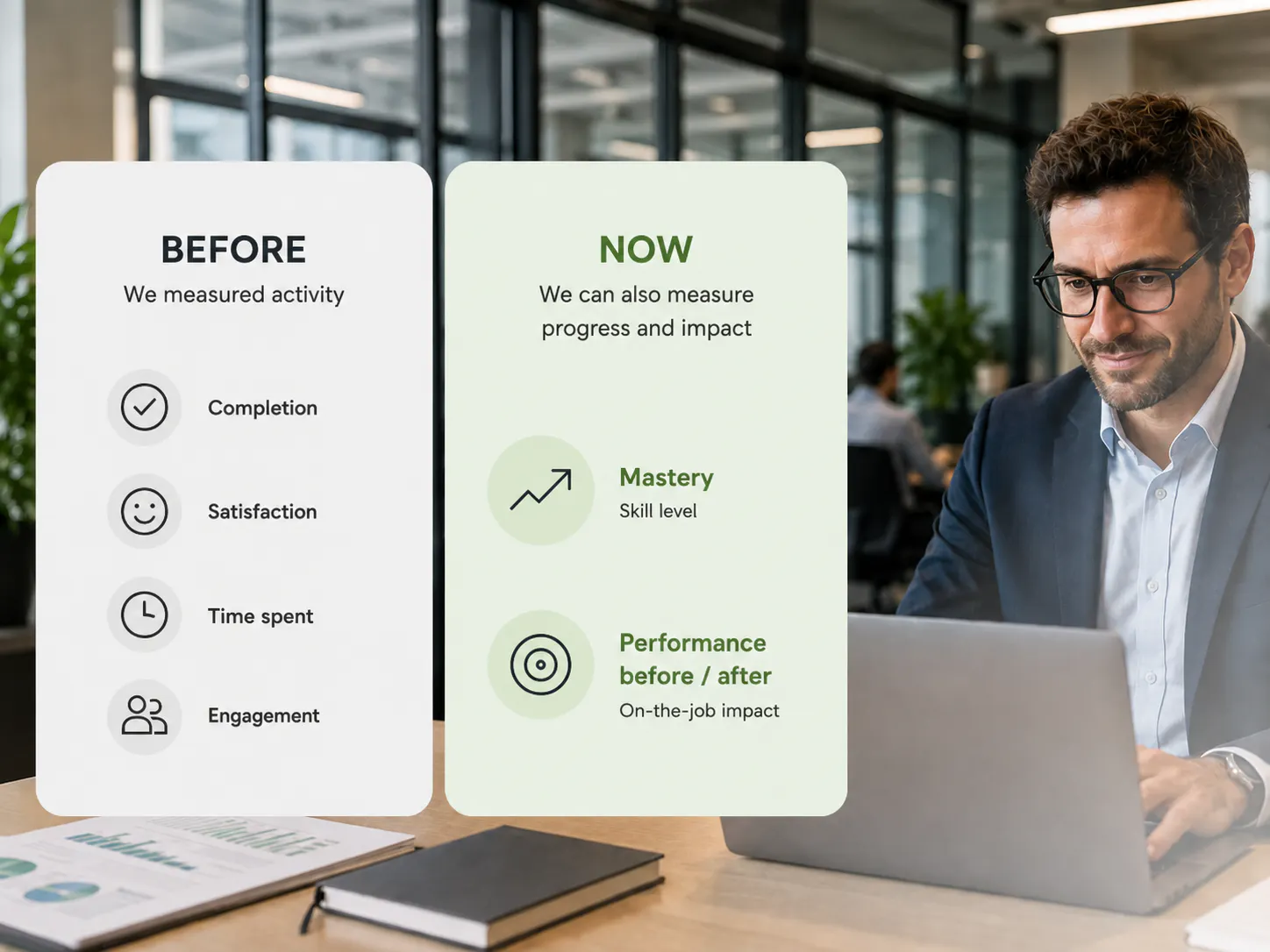
L&D teams have access to more data than ever before. Completion rates, learner satisfaction, time spent, and engagement levels mean that almost every learning initiative can now be tracked, managed, and analyzed.
These metrics have played a vital role in the digital transformation of learning. They have enabled organizations to monitor program adoption, understand how employees access content, and support the shift from predominantly classroom-based training to increasingly digital and blended learning journeys.
They remain essential for managing program delivery, improving the learner experience, and monitoring engagement.
But business leaders are increasingly asking a more demanding question: What measurable impact does learning have on performance?
The question is becoming more urgent. According to the LinkedIn Workplace Learning Report 2025, 49% of L&D and talent development professionals say their executives are concerned that employees lack the skills required to execute their business strategy. At the same time, the World Economic Forum’s Future of Jobs Report 2025 estimates that 39% of workers’ core skills will change or become outdated by 2030.
This is where traditional learning metrics reach their limits. They capture what employees did: logged in, participated, completed a course, or reported a positive experience. They reveal far less about what employees can do differently—and better—afterwards.
The goal is not to abandon these indicators, but to complement them with data that measures meaningful progress: changes in capability, behavior, decision-making, on-the-job application, and operational performance.
Traditional Learning KPIs still matter for tracking adoption
Completion rate: monitoring Learning journey adoption
Completion rate measures the proportion of learners who finish a course or learning journey. As a core LMS metric, it helps L&D teams monitor adoption, identify where learners disengage, and manage programme delivery at scale.
This KPI played a central role in the growth of digital learning. For years, the priority was to make training widely accessible and confirm that employees were using the new digital formats available to them.
Completion rate therefore remains a valuable indicator of participation and progression through a learning journey—but it does not show whether learning has changed workplace performance.
Learner satisfaction: evaluating the Learning experience
Learner satisfaction captures employees’ perceptions of a course or programme, usually through a post-training survey. It can provide insight into the relevance of the content, the clarity of the format, the quality of the learning experience, and the learner’s overall level of satisfaction.
This feedback is particularly useful for identifying areas for improvement, refining content and delivery, and understanding learner expectations.
However, a positive experience does not necessarily translate into knowledge retention, behaviour change, or improved performance.
Time spent: understanding how Learners engage with content
Time spent shows how long employees interact with a course, module, or learning journey. It can help identify topics that attract attention, sections that create friction, and potential issues with content structure or instructional flow.
It remains useful for analysing usage and improving digital learning experiences. But it should be interpreted carefully: more time spent may indicate strong engagement, cognitive challenge, confusion, or simply inefficient content.
Participation rate: monitoring programme reach
Participation rate measures the proportion of the target audience that accesses or begins a learning programme.
It helps L&D teams assess programme visibility, the effectiveness of internal communications, and adoption among priority employee groups.
These indicators also support the internal marketing of learning initiatives by showing which topics and formats attract attention, how effectively programmes reach their intended audiences, and where additional communication may be needed.
Why traditional Learning metrics measure usage, not performance
KPIs built for the first era of Digital Learning
Traditional learning metrics did not emerge by accident. They reflect the priorities that shaped digital learning over the past fifteen years.
The initial objective was to make training more accessible, scalable, and easier to deploy across large organizations. L&D teams needed to distribute content quickly to broad employee populations while maintaining visibility and control.
LMS platforms were central to this transformation. They centralized content, enabled consistent delivery at scale, tracked learner activity, and gave organizations greater visibility into their learning programmes.
Traditional KPIs were well suited to the challenges of this first phase: managing access, monitoring rollout, and measuring adoption.
The limitation: activity is not capability
The expectations placed on L&D have changed. The question is no longer simply, “Are employees completing training?” It is, “Can they perform better because of it?”
A skill is more than theoretical knowledge. It is the ability to make sound decisions, adapt to context, respond effectively, and apply what has been learned in real situations.
An employee can complete a course, understand the concepts, enjoy the experience, and achieve a high assessment score—yet still struggle to apply those skills effectively on the job.
This gap helps explain why many organizations find it difficult to demonstrate learning’s contribution to operational performance. A dashboard may show strong participation, completion, and satisfaction while workplace behaviours remain unchanged.
The problem is not that traditional KPIs are obsolete. They remain essential for managing adoption and improving the learner experience. Their limitation is more fundamental: they were designed to measure learning activity, not genuine capability development.
The real challenge: measuring progress, not just participation
Access to content remains essential. It enables employees to acquire knowledge, develop a shared vocabulary, and build a structured understanding of a subject.
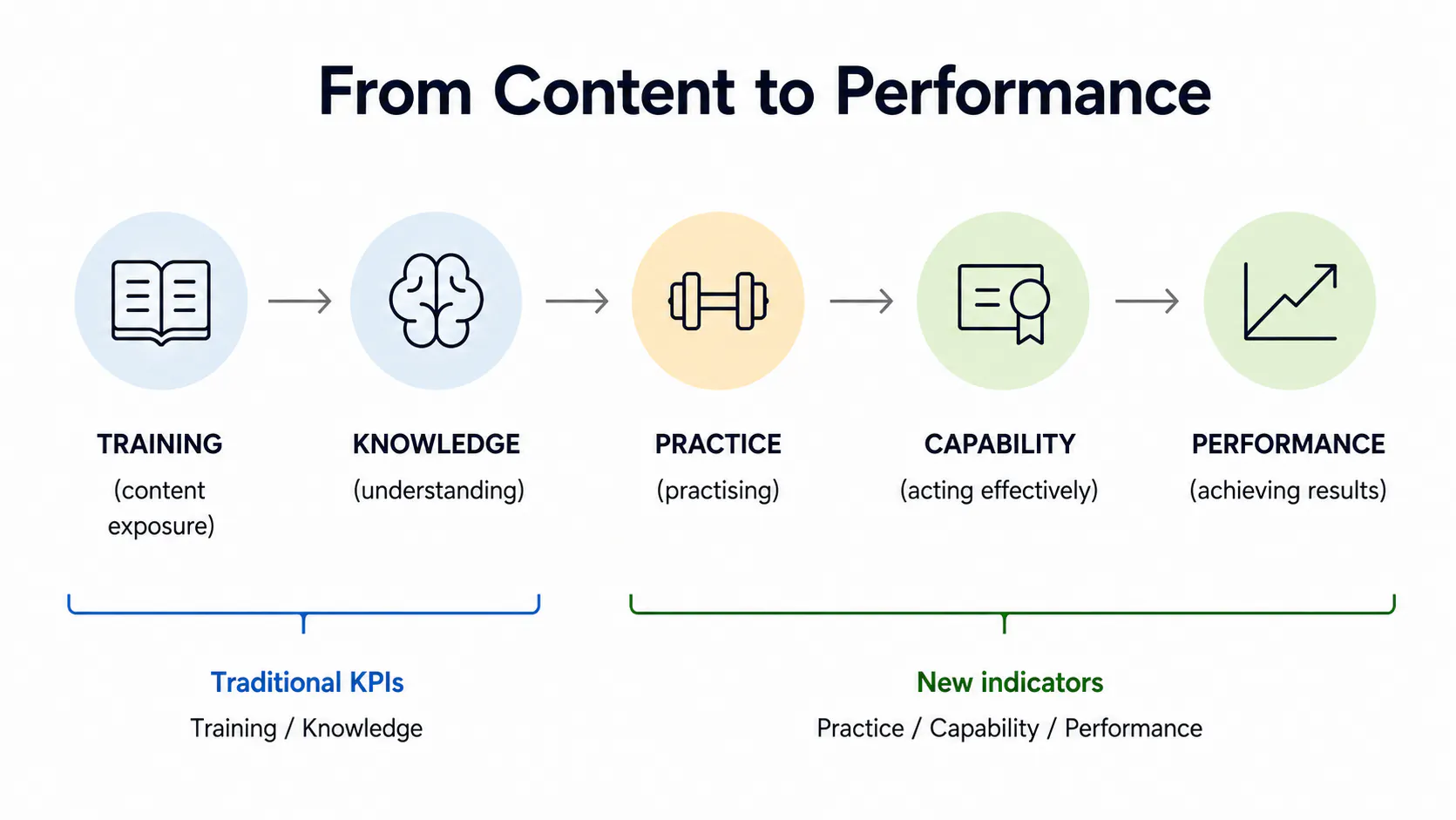
But knowing is not the same as doing. An employee may understand a method or remember a concept without being able to apply it effectively in a real work situation.
This distinction between knowledge acquisition and application is well established in cognitive science. Learning a concept does not guarantee transfer—the ability to retrieve, adapt, and use what has been learned in a context that is often more complex, uncertain, and imperfect than the original learning environment.
This is why employees can achieve excellent assessment scores and report high satisfaction while still struggling to apply their learning on the job. Developing genuine capability requires more than exposure to content. It also requires purposeful practice, repetition, feedback, and opportunities to apply learning in realistic situations.
It is precisely this gap between understanding and action that traditional learning metrics struggle to capture.
If a skill is the ability to act effectively, it cannot be assessed through content consumption alone. Capability becomes visible when employees must use their knowledge in situations involving constraints, uncertainty, pressure, human interaction, and incomplete information.
In practice, this means making sound decisions, solving problems, adapting behaviour, and responding effectively to the situation at hand.
An employee may, for example, know every recommended technique for handling sales objections. But when faced with an unpredictable and demanding customer, they may still struggle to choose the right response and deliver it effectively.
This gap is not a sign that learning has failed. It often means that a critical stage is missing: practice in conditions that reflect the realities of work. Measuring an employee’s ability to practise, improve, and perform in context opens the door to a new generation of learning metrics.
New Learning metrics: making real progress measurable
Next-generation platforms are expanding what L&D can measure
The latest generation of learning platforms, powered by artificial intelligence, enables far more active learning experiences: adaptive pathways, realistic simulations, AI-coached practice, automated feedback, and on-demand expert support.
The objective is no longer simply to expose employees to content. It is to help them practise, improve, and perform in situations that reflect the realities of their work.
This evolution is expanding the range of KPIs available to L&D teams. As learning becomes more practical, contextual, and continuous, organizations can begin to measure:
- demonstrated mastery;
- progress over time;
- the ability to perform in realistic situations;
- readiness for critical business scenarios.
These indicators are still emerging in many organizations, but they are already changing how L&D approaches capability development and workforce planning.
Measuring demonstrated mastery
Through Adaptive Learning and personalized learning journeys, platforms such as Teach Up can provide a more granular view of employees’ mastery of essential knowledge.
The goal is no longer simply to confirm that a module was completed. It is to determine whether the learner has genuinely understood and retained the concepts required to perform.
L&D teams can therefore monitor:
- the percentage of employees reaching a defined mastery threshold;
- the knowledge areas that require further development;
- mastery gaps across teams, roles, or employee groups.
Tracking behavioural progress over time
AI-coached practice can also make progress in workplace behaviours more observable. Depending on the scenario, teams can track improvements in areas such as:
- response quality;
- interpersonal effectiveness;
- objection handling;
- the structure of an interaction;
- needs discovery and reformulation;
- the clarity and persuasiveness of an argument.
The measurement logic changes entirely. The question is no longer, “Did this employee attend the training?” but “Are repeated practice and feedback helping them perform better over time?”
Measuring the ability to perform in realistic situations
Simulations can provide evidence of whether employees are ready to handle critical workplace situations.
This is particularly valuable when performance depends on the ability to make decisions and act effectively under pressure, including in:
- customer service;
- sales;
- management;
- negotiation;
- compliance;
- sensitive or high-stakes situations.
Some organizations are beginning to track a readiness rate: the percentage of employees who demonstrate the required level of performance in realistic simulations and are considered ready to act independently on the job.
Measuring Learning in the flow of work
Embedded coaching and performance support can now help employees at the moment a challenge arises.
Learning is no longer confined to scheduled courses or dedicated training sessions. It becomes an operational resource that employees can access when and where they need it.
Organizations can begin to monitor:
- the number or proportion of workplace challenges resolved with expert support;
- the frequency and nature of real-time assistance requests;
- recurring issues identified and addressed in the flow of work.
This brings learning closer to day-to-day business priorities—and enables L&D to move from reporting activity to demonstrating capability and operational impact.
How new Learning metrics are reshaping L&D
These metrics are doing more than changing how organizations evaluate training. They are redefining the role L&D can play in improving workforce capability and business performance.
From managing courses to developing capability
L&D teams can now build a clearer picture of:
- the knowledge and skills employees have genuinely mastered;
- the situations in which they still struggle;
- the behaviours that are improving through practice;
- the teams or employee groups that require additional support.
This shifts the focus of L&D from producing and administering content to developing workforce capability and enabling performance in the flow of work.
Giving managers actionable insight
These new data points also enable L&D to become a more valuable partner to managers and business leaders.
They can help teams identify capability gaps, diagnose performance barriers, prioritize support needs, target learning interventions, and track meaningful development over time.
Learning is no longer simply a catalogue of courses. It becomes a source of insight that supports better decisions, more effective coaching, and continuous performance improvement.
Establishing L&D as a strategic Business function
As organizations seek to build critical skills faster and demonstrate measurable operational impact, L&D is being asked to take on a more strategic role.
Success is no longer defined by how much content is delivered or how many employees it reaches. It depends on identifying the capabilities the business needs, accelerating their development, and demonstrating how learning contributes to performance.
L&D is therefore evolving from a training management function into a genuine business partner—and a driver of organizational transformation.