
How much does an LMS cost?

When companies start looking into an LMS, the first question is often the same: how much should they budget for such a project? It is a legitimate question, but also one of the most difficult to answer.
Why? Because an LMS is not an off-the-shelf product with a single fixed price. Its cost depends on many factors: the size of your organisation, your learning objectives, the level of support you expect and the features you actually need.
More importantly, the price displayed by a provider represents only part of the investment. Implementation, content creation, integrations with your existing tools, team support and maintenance must all be taken into account. The real question is therefore not simply how much an LMS costs, but what budget you need to make your LMS project successful.
In this article, we review the main costs associated with an LMS project, the factors that genuinely influence its price and the method to use when comparing proposals.
Understanding what influences the cost of an LMS
Before comparing platforms, it is important to understand why prices vary so widely across the market.
A quick search will show that two solutions can have very different prices while appearing to address similar needs. This does not necessarily mean that one platform performs better than the other. Above all, it reflects different business models, service levels and functional scopes.
Not all LMS platforms are sold in the same way
Today, most LMS platforms are provided through a SaaS subscription. However, each provider applies its own pricing model.
Some charge according to the total number of users registered on the platform. Others use the number of active users, that is, employees who actually log in during a given period. Other providers offer a fixed subscription or charge for additional options based on the selected features or level of support.
At first glance, two proposals may therefore appear comparable even though they are based on very different pricing models. Before comparing prices, always take the time to understand exactly what each offer includes.
The cost depends primarily on your project
An LMS budget does not depend solely on the platform you select. It also depends on your context. The licence price provides an initial reference point, but it is not enough to compare two projects. A higher-priced offer may include more services, reduce administration time or prevent additional expenditure elsewhere.
For example, an SME looking to deliver a small number of onboarding modules will not have the same needs as an international organisation that must train several thousand employees, manage numerous programmes, support several languages or connect its LMS to its HRIS.
The cost will also vary depending on whether you already have learning content, need to produce it from scratch or want to integrate an authoring tool into the platform. In other words, the LMS alone does not determine the budget. Your project as a whole does.
To get a more accurate view, you must therefore consider the scope covered by each proposal and the total cost of the project.
What budget should you plan for an LMS in 2026?
Although there is no single price, it is still possible to provide some broad benchmarks.
An LMS can cost anywhere from a few thousand euros to several tens of thousands of euros per year.
The main factors influencing the budget are:
- the number of learners;
- the required features;
- the integrations needed;
- the level of support;
- the complexity of the implementation.
Indicative budgets by project type:
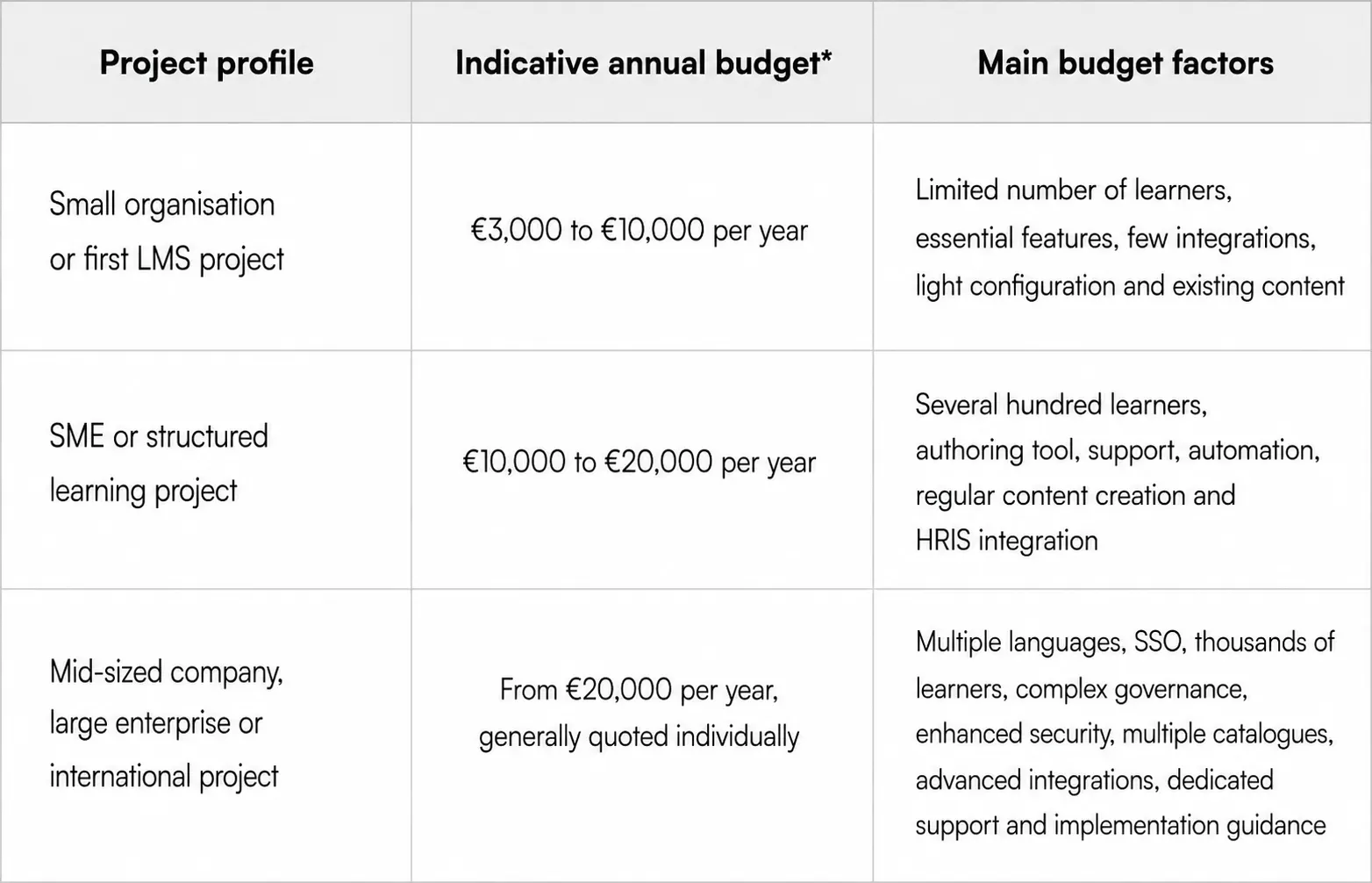
*Indicative ranges based on publicly available prices and market benchmarks reviewed in 2026. Depending on the proposal, these amounts may cover the licence alone or include part of the implementation, support and guidance. Offers must therefore be compared on an equivalent scope.
In addition, some platforms charge per registered user or active user. As an indication, published market prices can range from €5 to €30 per user per month. This variation reflects differences in features, included services and levels of support.
However, the price per user is not always the most relevant indicator. A platform may appear attractive when its unit price is low but become less cost-effective if a large proportion of accounts remain inactive. Conversely, a higher subscription may generate more value if it automates enrolments, reduces administration time, accelerates content production or improves participation in learning programmes.
To get a more representative indicator, you can calculate: Cost per learner actually trained = total annual project cost ÷ number of learners actually trained during the period
Price ranges provide an initial indication. To understand what the budget really covers, let us now examine the main areas of expenditure in an LMS project.
What costs should you expect in an LMS project?
The licence: the most visible cost but not always the most important
When you request a proposal from a provider, the first line usually corresponds to the licence fee. It is also the figure that immediately attracts the most attention.
However, two licences with similar prices may cover very different services. Some include support, updates and certain advanced features. Others charge for these services separately.

Best practice
Check exactly what the licence includes: support, updates, advanced features and guidance. Two similar prices may cover very different services.
Implementation: the project’s success is often determined before launch
An LMS platform does not become operational as soon as it is made available.
Before employees can begin their training, several steps are required: configuring the platform, importing users, creating learning catalogues, setting up learning paths and customising parts of the interface.
The more complex your organisation, the more time and coordination this phase will require.
This is particularly true if you are replacing an existing LMS. Migrating users, training histories and learning content often requires a significant amount of preparation.

A question
to ask yourself
Are you implementing your first LMS or replacing an existing platform? A migration requires you to plan for the transfer of data, content and training histories.
Integrations: an investment that saves time every day
Today, an LMS rarely operates independently within your digital environment.
It often needs to communicate with your HRIS, collaboration tools, CRM or other business applications.
These integrations represent an investment, but they also automate many tasks: account creation, enrolment in mandatory training, data synchronisation and automatic report generation. Over time, they significantly reduce the need for manual processing.

Best practice
Do not consider only the price of the integration. Also estimate how many hours of data re-entry and administration it will save every year.
Content creation: the most frequently underestimated cost
This is probably the cost companies anticipate least. An LMS provides the platform, but content is what brings the learning programme to life.
Creating the first modules already requires an investment. Keeping them up to date requires another. Procedures evolve, regulations change and products are renewed. Your content must keep pace with these developments.
This is why platforms that include an authoring tool, LCMS-style functionality or Artificial Intelligence capabilities can represent a genuine productivity driver.

Key takeaway
Buying an LMS without planning for content creation and maintenance is a little like building a library without any books. Before launching your project, ask yourself who will produce the learning content, and who will keep it up to date.
Support and guidance: a key success factor
Choosing an LMS is not enough to guarantee its success. For the platform to be widely used, it must first be easy to learn and navigate.
An intuitive user experience allows both administrators and learners to become autonomous quickly, limits training requirements and supports adoption from the very first interactions.
Support nevertheless continues to play an essential role, particularly in structuring the project launch, training administrators, communicating with employees and helping teams make full use of the platform.
These activities represent an investment, but they contribute directly to lasting LMS adoption and the overall success of the project.

Teach Up’s
recommendation
An intuitive interface naturally facilitates LMS adoption. Support should not compensate for a complex platform; it should help teams use the platform to its full potential. Combining a strong user experience with the right level of guidance is what supports lasting adoption.
Maintenance and development: think about your LMS five years from now
The cost of an LMS does not end when the platform goes live. Your organisation will evolve, and so will your requirements.
You may develop new learning paths, introduce new learner populations, open international subsidiaries or want to take advantage of the latest innovations, particularly those involving artificial intelligence. Your platform must be capable of supporting these developments.

A question
to ask yourself
Will your LMS be able to accommodate new learner populations, new catalogues or an international deployment without requiring a complete redesign?
How should you assess the cost of an LMS and compare proposals?
Once you have received several proposals, you still need to compare them on an equivalent basis. Price should not be considered in isolation. Your analysis must also account for functional scope, included services and the resources each solution will require over time.
Start by defining your needs
Before requesting a proposal, take the time to formalise your project.
This may seem obvious. However, many tenders are launched before the organisation’s requirements have been clearly defined. Begin by asking yourself a few questions:
- How many employees will receive training?
- Do you want to deliver a few e-learning modules or build a complete learning catalogue?
- Do you already have learning content?
- How many people will administer the platform?
- Does the LMS need to connect to your HRIS or other tools?
- Do you need an authoring tool or artificial intelligence features?
The answers to these questions will have a direct impact on the cost of the project.
Build a comparison framework
Once you have received the proposals, resist the temptation to rank them solely by price. Instead, create a common evaluation framework.
For example, compare each solution using the following criteria:
- the pricing model;
- the features included in the licence;
- the implementation services;
- the available integrations;
- content creation or migration;
- the quality of support;
- the guidance provided;
- the product developments included in the subscription.
This approach allows you to compare platforms objectively. It also highlights potential costs that may not be immediately visible in the proposals.
Consider the total cost, not only the purchase price
Comparing two licence fees is not enough. You must also estimate what each platform will cost your organisation over several years.
Take into account administration time, potential development work, content maintenance, support requirements and future changes to the project. A more comprehensive offer may prove more economical if it reduces these costs over time.
This approach allows you to assess the platform’s total cost of ownership rather than its purchase price alone.
Assess the cost of the status quo
Assessing the required investment is not enough. To make an informed decision, you must also compare it with the cost of your current operating model. What is the cost of changing nothing?
Continuing to manage learning across several tools, multiplying Excel files, re-entering data or spending several hours each week on administrative tasks also carries a cost.
This is before considering the consequences that are more difficult to measure:
- lower participation in learning programmes;
- content that quickly becomes outdated;
- limited visibility and reporting;
- an unengaging learner experience.
In other words, deciding not to invest in an LMS is also a decision with a cost.
Conclusion: compare value, not just price
The cost of an LMS depends on the scope of the project, the services included, the integrations required, the content to be produced and the resources needed over time.
To build a realistic budget, start by defining your intended uses and priorities. Then compare proposals using a common framework that includes the total project cost, the time saved by teams and the platform’s ability to support future needs.
This analysis must also take the cost of the status quo into account. Maintaining manual processes, fragmented tools or content that is difficult to update already represents an expense for the organisation.
An LMS is therefore not simply a line in a budget. When chosen well, it can simplify learning administration, accelerate content creation, improve the learner experience and strengthen the management of learning programmes.
More than an expense, an LMS is an investment. When it is suited to your needs and implemented correctly, it not only helps you train employees more effectively, but also saves time, strengthens processes and turns learning into a genuine performance driver.
Frequently asked questions
How much does an LMS cost for an SME?
For an SME, the budget generally ranges from a few thousand euros to approximately €20,000 per year, depending on the number of learners, the required features, integrations and level of support. More complex or multi-entity projects may exceed this range.
Is an open-source LMS really free?
The software may be available free of charge, but its hosting, configuration, maintenance, security and support require internal or external resources.
What are the main LMS pricing models?
The most common models are based on the number of registered users, the number of active users or a fixed annual fee. Some features may be charged separately.
How can you measure the return on investment of an LMS?
The calculation can include the administrative time saved, the reduction in manual tasks, savings on certain in-person learning activities, improved engagement and the avoided cost of maintaining the status quo.
Vous souhaitez en savoir plus sur Teach Up ?
Prenez rendez-vous avec un expert et découvrez notre solution LMS !