
AI coaching, AI simulations and AI role-play: towards a new model for online learning?
Organizations have never invested more in workplace learning. Learning platforms have proliferated, content is available on demand, and development journeys are increasingly structured. On paper, all the conditions are in place to build workforce capabilities at scale.
And yet, only 26% of organizations believe they are effectively developing the skills required to deliver their strategy, according to Gartner’s Top Priorities for CHROs 2026 report.
In other words, workplace learning is everywhere—but its impact remains limited.
The limits of Learning platforms (LMS, LXP, LCMS): is the model too content-centric?
Look at how workplace learning is structured today, and one thing quickly becomes clear: the entire system still revolves around training content.
Learning management systems (LMS) help organisations structure and deliver learning programmes.
Learning experience platforms (LXP) make content easier to discover and help drive learner engagement.
Historically, the learning ecosystem was designed to give employees frictionless access to knowledge. This content-centric model has successfully enabled organisations to deliver learning at scale: digital learning now accounts for a significant share of corporate training, and blended approaches have become widespread.
But this model is beginning to reach its limits. A substantial proportion of learning content is underused, duplicated or quickly forgotten. Content exposure alone does not produce lasting learning. Without active retrieval, repeated practice, feedback and personalisation to individual needs, knowledge is less likely to be retained and applied in the workplace. Research has consistently shown that retrieval practice produces more durable learning than repeated exposure alone (Karpicke and Roediger, Science).
This brings us to the heart of the problem: practice still plays a marginal role in many corporate learning programmes. According to It’s Time for an L&D Revolution, only 3% of organisations currently use virtual reality and simulationsas part of their learning strategy (The Josh Bersin Company).
This imbalance is increasingly at odds with what employees need. Learners do not simply want access to more resources: they want opportunities to apply what they have learned to realistic situations, experiment safely, receive feedback and improve.
The result is a widening divide: on one side, an ecosystem optimised to distribute content; on the other, a growing need for practice, experimentation and real-world application.
What are the benefits of AI-powered skills practice solutions, such as coaching, simulations and role-play?
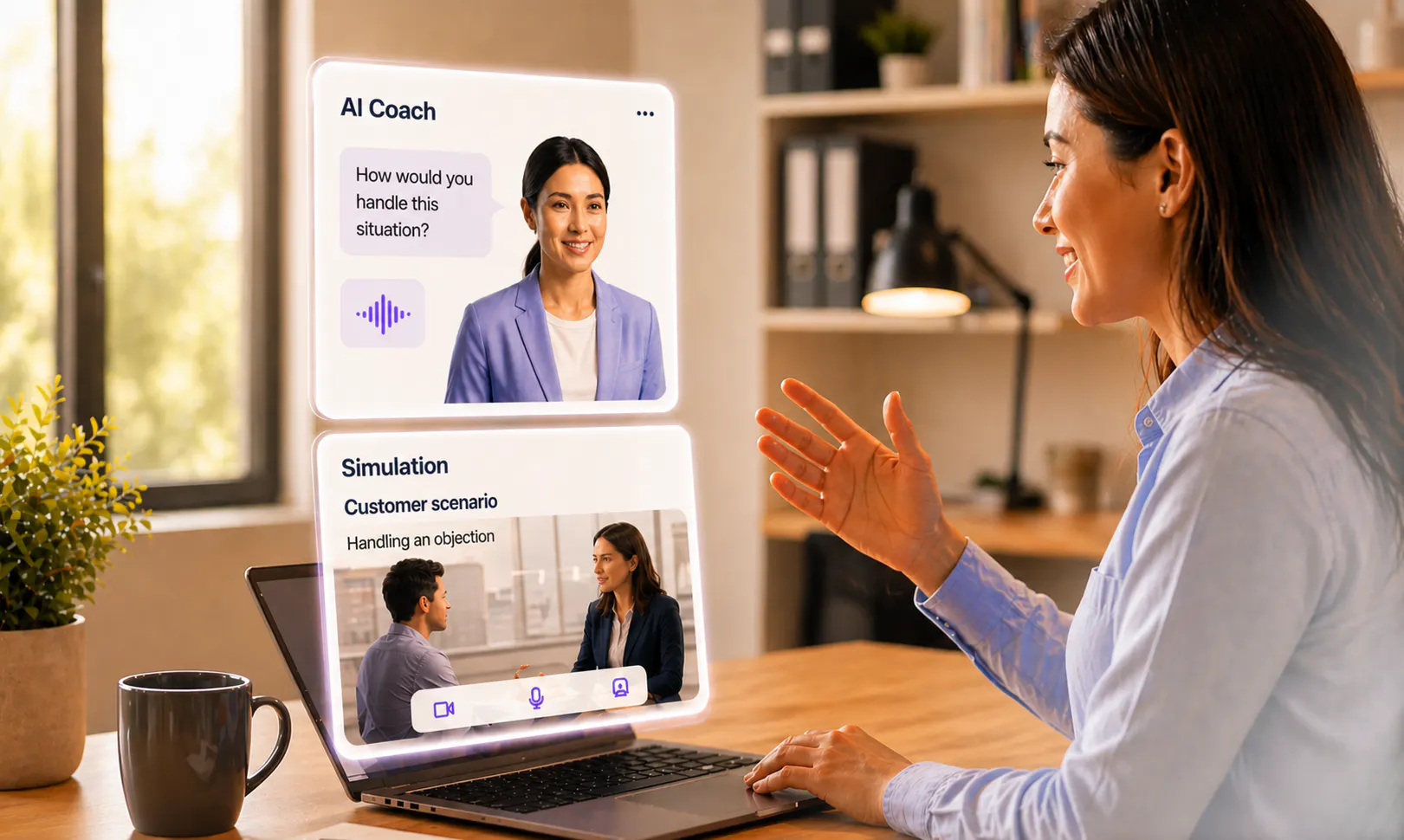
A new generation of AI-powered tools is emerging to address this challenge. Rather than simply delivering content, these solutions enable employees to practise skills online through immersive, interactive experiences.
AI coaching, simulations and role-play all introduce the same fundamental shift: learners no longer simply absorb information—they practise applying it. Instead of reading content or watching a video, they engage with realistic workplace scenarios that require them to:
- make decisions in real time;
- test different approaches, make mistakes and try again;
- improve through continuous analysis and feedback.
Some tools use immersive simulations to place employees in situations that closely reflect their day-to-day work. Learners might need to handle a request, make a decision or respond to the consequences of their actions.
These digital role-play experiences are particularly well suited to developing behavioural, leadership and sales skills. Learners take part in realistic simulated conversations and discover how to adapt their behaviour, refine their approach and communicate more clearly in different contexts.
Other solutions use AI coaches that can engage learners in conversation, challenge their responses and generate personalised practice scenarios. This makes individualised skills practice available at any time and at scale.
AI simulations, AI coaching and AI role-play: what are the limitations of these formats?
More than half of organisations now say they intend to incorporate skills practice tools into their learning programmes (Cegos 2024 International Barometer), while nearly 55% plan to invest in AI-based simulation products (Very Up, L&D Exploration Observatory 2025).
Skills practice is now more accessible, immersive, measurable and scalable than ever. But practice alone is not enough—particularly when it focuses on a limited number of tightly scripted use cases.
More fundamentally, isolated practice does not reflect what cognitive science tells us about lasting learning. Learning does not result from exposure to a situation alone. It depends on a combination of active mechanisms, including retrieval practice, spaced learning, interleaving different scenarios and adapting the level of challenge to each learner.
A one-off practice activity can still deliver value, even without a structured sequence or reinforcement over time.
But its impact will remain limited.
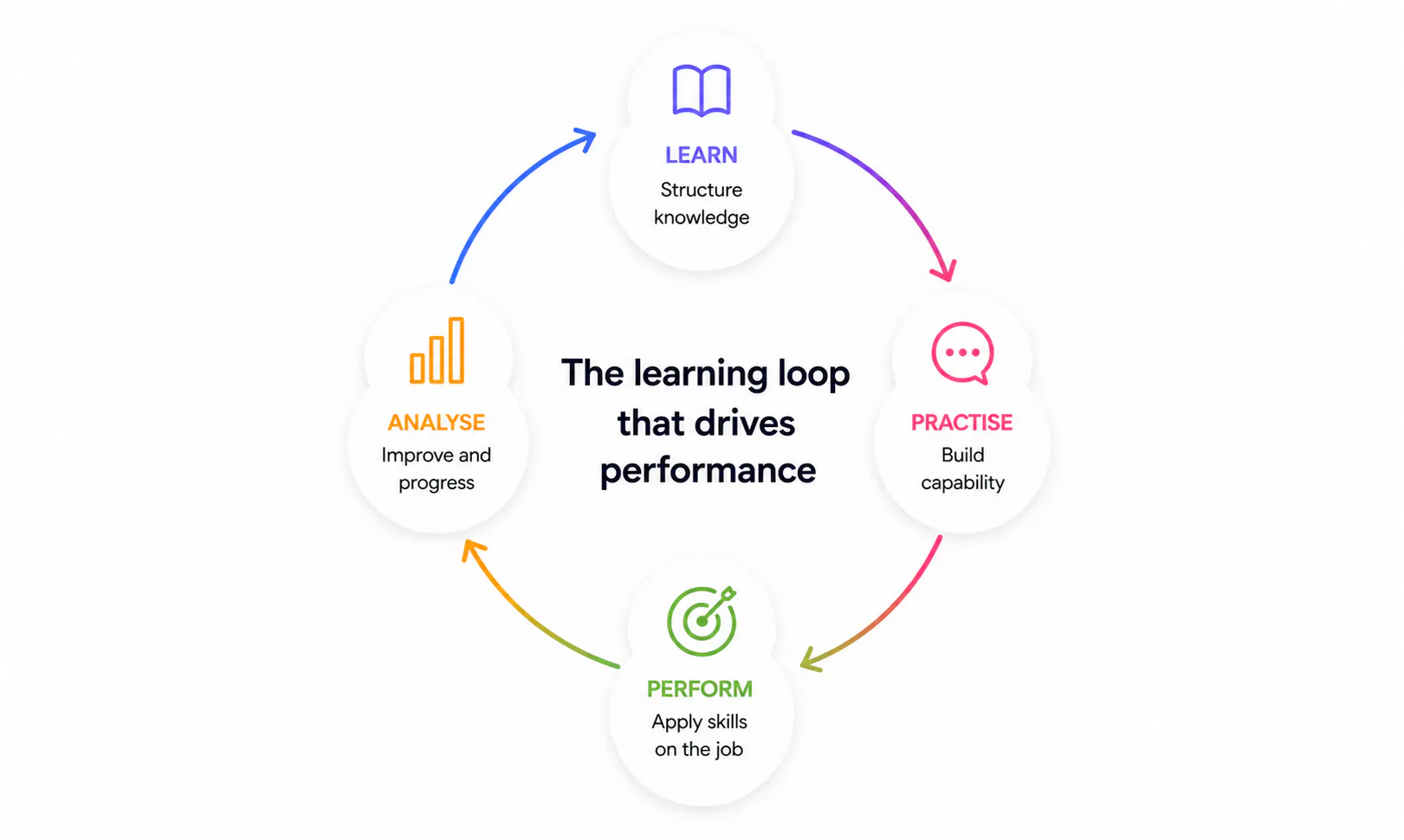
Learn, practise, perform, analyse: the continuous learning loop
Research into training effectiveness shows that meaningful learning requires four core elements: information, demonstration, practice and feedback (Salas et al., 2012).
Yet this connected learning cycle—combining active practice with continuous feedback—is precisely what most solutions still lack. This is true both of content-centric digital learning platforms and of the new generation of standalone practice tools.
Training alone is not enough. Practice alone is not enough either.
Skills development can no longer be treated as an accumulation of content or isolated experiences. It must be designed as a continuous progression system.
- Learning structures knowledge.
- Practice turns knowledge into capability.
- Performance puts that capability to work in real situations.
- Analysis reveals what needs to change and drives further improvement.
The value does not come from any one stage in isolation. It comes from the loop.
From online learning to skills practice: the role of Adaptive Training
That is exactly why we developed Adaptive Training at Teach Up. We do not define it as a collection of standalone features, but as an experience that organises learning around each learner’s measurable progress.
In practice, Adaptive Training connects every stage of the journey: content structures knowledge, simulations provide opportunities to practise, coaching helps learners improve, and data makes progress visible and actionable. Every interaction informs the next, while each stage builds on what came before. The individual components are not what make the difference. The value lies in how they work together.
In a world where skills are constantly evolving, the ability to transfer knowledge and develop capabilities continuously has become a strategic priority. This is no longer simply a learning challenge. It is essential to sustainable performance.