
What are the benefits of an LMS for businesses?
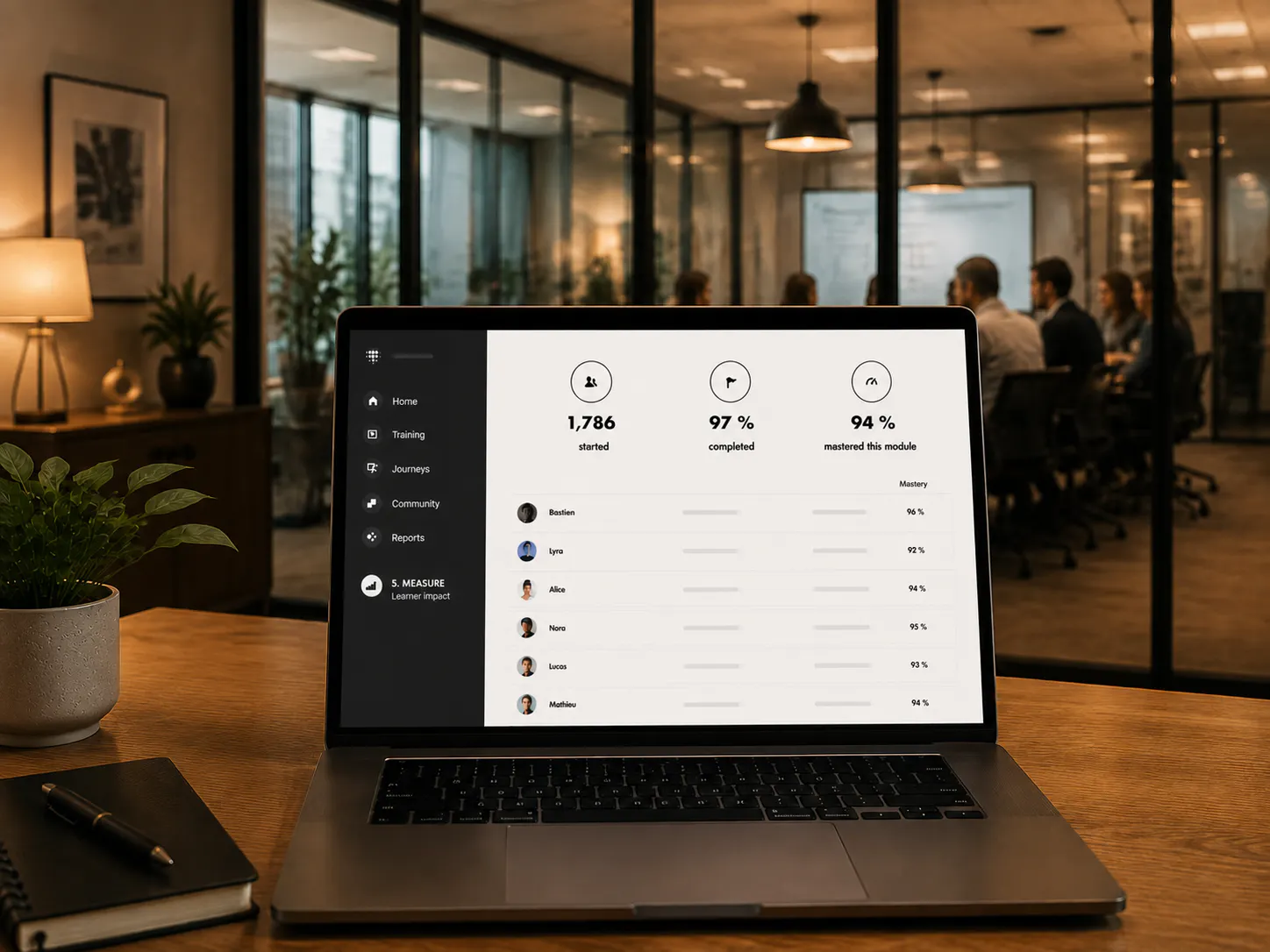
In many organizations, learning quickly becomes difficult to manage. Content is scattered across multiple tools, learning journeys lack consistency, learner tracking depends on spreadsheets, and HR and L&D teams spend significant time on repetitive administrative tasks.
This is often when organizations begin considering an LMS (Learning Management System). More than a platform for delivering courses, an LMS centralizes learning content, structures development journeys, tracks learner progress, manages certifications and skills, and provides a single environment for overseeing digital learning programmes.
Today, organizations use LMS platforms for a wide range of purposes, including employee onboarding, e-learning, blended learning, virtual training, certification management, regulatory compliance, and job-specific skills development. They also provide reporting, dashboards, and learning analytics that help teams improve the learner experience and increase programme effectiveness.
But what are the practical benefits of an LMS for an organization? How can it improve learning administration, decision-making, performance, and skills development? This article explores the advantages that matter most.
What is an LMS?
An LMS, or Learning Management System, is a platform that enables organizations to structure, deliver, and track their learning programmes. It brings learning content, development journeys, learner data, assessments, and reporting together in one environment.
In practical terms, an LMS enables organizations to:
- centralize learning content
- structure learning journeys
- automatically assign training based on learner profiles
- monitor learner progress
- manage assessments, completion records, and certifications
- oversee learning programmes through dashboards and reporting
An LMS therefore plays a central role in a digital learning strategy. It creates consistency across skills-development initiatives and makes learning easier to manage at an organizational level.
The key features and benefits of an LMS
An LMS does far more than host e-learning modules. Its real value lies in its ability to structure, automate, and measure an organization’s entire learning ecosystem.
The 10 key benefits of an LMS
Whatever the size of your organization, these are the benefits most commonly associated with successful digital learning initiatives:
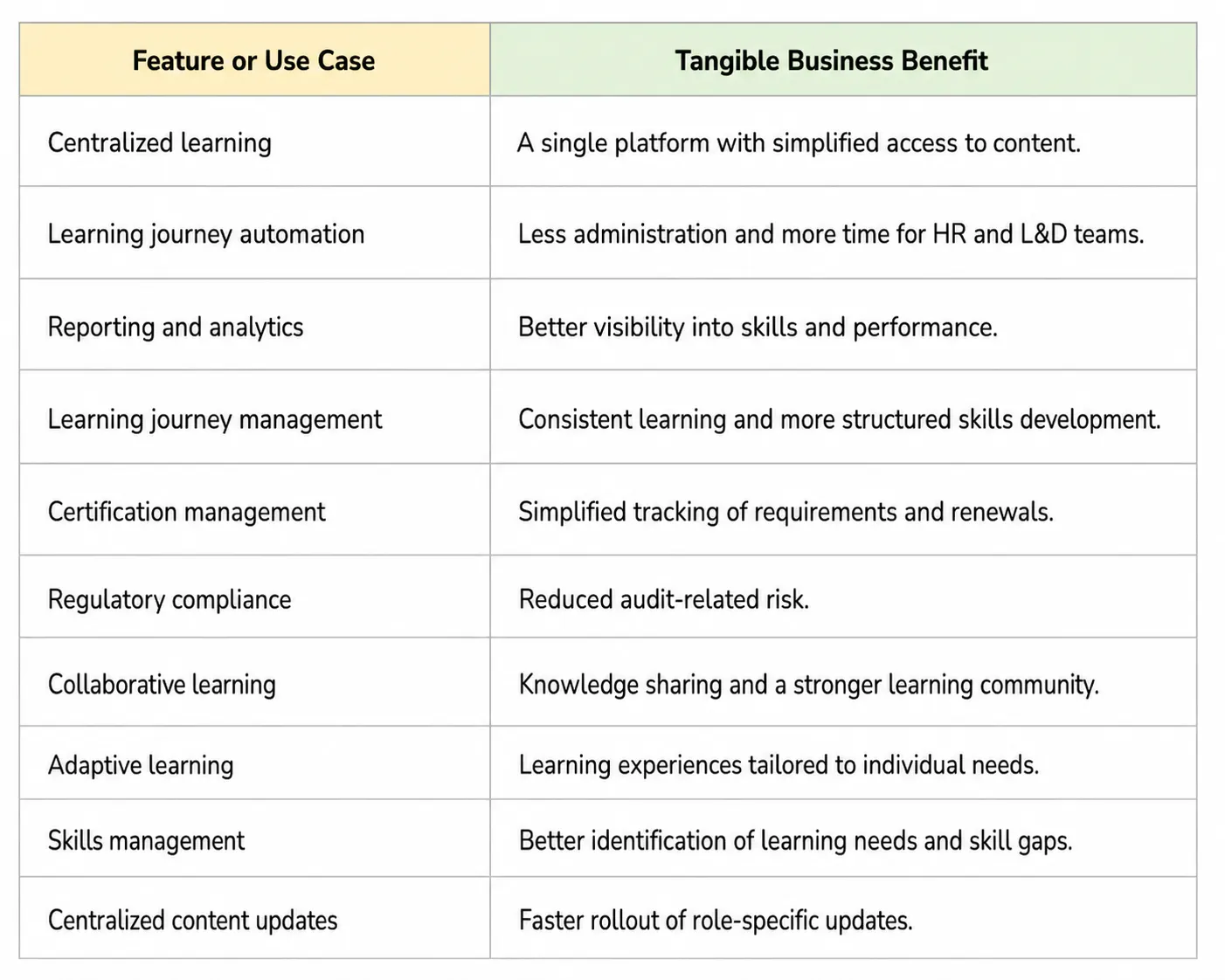
Centralize Learning in one place
Without an LMS, learning is often fragmented across multiple channels: classroom sessions, shared drives, internal documents, videos, collaboration tools, and loosely organized catalogues. Employees must search for information across different sources and may struggle to understand which learning opportunities are available.
An LMS changes this experience by bringing content together in a single online learning platform. The catalogue becomes structured, continuously accessible, and designed to help employees find and use the learning they need.

For instance
A multi-site organization can deliver a consistent learning foundation across its workforce, including interactive modules, role-specific resources, quizzes, virtual classes, and skills-development journeys. Everything is accessible in one place, with consistent tracking rules and learning standards.
Automate time-consuming tasks for L&D and HR teams
One of the most tangible benefits of an LMS is automation. Tasks such as enrolment, reminders, progress tracking, and data exports often require significant manual effort. A modern LMS can manage much of this work automatically.
Depending on the platform, organizations can automate:
- training assignments based on role, profession, or team;
- enrolment in learning journeys;
- reminders for overdue or incomplete modules;
- certification renewals;
- notifications to managers and administrators;
- progress-report generation;
- completion-record and certificate delivery.
Automation reduces repetitive work, improves tracking reliability, and gives L&D and HR teams more time to focus on higher-value priorities, including learning design, manager enablement, needs analysis, and continuous programme improvement.
For instance
When a new employee joins a customer support team, the LMS can automatically enrol them in a role-specific journey covering core job knowledge, internal procedures, compliance requirements, and progressively more advanced skills. The experience adapts to their profile without requiring the L&D team to manage every stage manually.
Track Learner progress and structure Learning Data
An LMS enables organizations to move beyond managing learning with limited visibility. Interactions with content can generate valuable data on learner progress, assessment results, completion, engagement, and differences between employee groups.
L&D teams can monitor:
- learner progress;
- completion and drop-off rates;
- quiz, assessment, and certification results;
- skill gaps by team, role, or location;
- the most frequently accessed and least frequently completed content;
- engagement across learning journeys.
This information is typically presented through customizable dashboards and reports. L&D leaders, HR teams, and managers can monitor relevant indicators and make better-informed decisions.
This is also where learning analytics becomes valuable. By analysing LMS data, organizations can identify friction points, highlight content that needs improvement, and detect support or development needs more quickly.
For instance
If two teams complete the same programme but achieve very different results, LMS data can reveal the gap and guide the response—whether that means revising a module, adjusting the level of difficulty, or strengthening manager support.
Enable collaborative Learning and knowledge sharing
An LMS can also become a space for collaborative learning. Knowledge no longer flows only from the L&D team to employees; learning can also be shaped by workplace feedback, shared experience, internal expertise, and proven practices.
Depending on the platform, collaborative learning may include:
- learning communities;
- discussion forums and shared spaces;
- peer-to-peer resource sharing;
- feedback and lessons from workplace experience;
- content created by internal trainers or subject-matter experts;
- the capture and sharing of organizational best practices.
For instance
A sales team can share insights from customer meetings, contribute to a knowledge base, and help create useful resources for new starters. These materials then become available to the entire team, turning individual experience into shared organizational knowledge.
Adapt Learning to modern working habits
Learning habits have changed significantly. Employees now expect workplace learning tools to provide the same simplicity as the digital services they use every day: fast access, concise formats, mobile availability, and a seamless experience.
Modern LMS platforms therefore support a range of formats and approaches:
- Mobile learning gives employees access to content from a smartphone or tablet. It is particularly valuable for field-based, sales, and technical teams that do not work permanently at a desk.
- Blended learning combines digital and instructor-led learning to create more complete development journeys. Digital content can prepare learners for live sessions, extend the experience, or reinforce what was covered.
- Adaptive learning adjusts selected content, difficulty levels, or recommendations according to a learner’s proficiency, responses, and progress.
- Microlearning divides learning into short, focused activities that are easier to integrate into a busy working day.
The objective is to make learning more accessible, relevant, and easier to incorporate into employees’ everyday work.
For instance
A technician can access a procedure on their phone just minutes before carrying out a task. There is no need to search across multiple systems or wait for a scheduled training session—the information is available at the moment of need.
Support regulatory compliance and mandatory training
Compliance is one of the most important LMS use cases, particularly in highly regulated sectors. Health and safety, GDPR, cybersecurity, professional licences, and industry certifications all require reliable records. Manually tracking who completed what—and when—quickly becomes complex.
An LMS centralizes mandatory training and maintains an auditable record over time.
Depending on the platform, organizations can:
- automatically track mandatory training;
- manage completion records, licences, and certifications;
- retain evidence of completion;
- send reminders before deadlines or expiry dates;
- generate reports for audits;
- identify employees who are compliant and those who need to renew a certification.
For instance
An industrial company may need to confirm that hundreds of employees have completed the required safety training before they can work with specific equipment. Without an LMS, teams must reconcile multiple spreadsheets, follow up with overdue learners, and reconstruct evidence whenever an audit takes place.
What tangible benefits does an LMS deliver to the business?
LMS functionality matters, but its real value is measured through organizational outcomes: time saved, greater visibility, more reliable management, reduced risk, and more structured skills development.
Faster access to Learning content
When content is scattered across different tools and teams, employees lose time before learning even begins. They search for the right documents, managers repeatedly answer the same questions, and HR teams spend time directing people towards the appropriate resources.
An LMS organizes these resources within a single environment. Learners know where to go, what to complete, and in which order. Learning journeys become clearer, and relevant content is easier to find.
Lower coordination costs
Without an LMS, learning administration often depends on a long series of manual tasks: enrolments, reminders, attendance tracking, data consolidation, report exports, and certificate delivery.
Individually, these tasks may seem minor. Over a year, however, they can represent a considerable workload for HR and L&D teams.
By automating many of these processes, an LMS reduces coordination costs and allows teams to focus on more strategic work, including content improvement, manager enablement, skills analysis, and learning-performance management.
Faster time to competence
Delivering training is not an end in itself. The objective is to help employees become confident, effective, and independent in their roles as quickly as possible.
By providing structured journeys, content aligned with learner proficiency, and continuous progress tracking, an LMS can reduce the time required for employees to develop the capabilities expected in their roles.
The resulting benefits can be highly practical:
- faster onboarding and time to productivity;
- stronger process knowledge;
- fewer operational errors;
- more consistent access to essential knowledge;
- greater confidence in applying new skills.
LMS data can also support more credible analysis of learning ROI. Teams can track progress, compare outcomes, and—when learning data is connected with relevant business indicators—better understand how development initiatives contribute to organizational objectives.
Better skills management with managers and subject-matter experts
For many years, workplace learning was managed almost exclusively by HR and L&D teams. Yet the most important capability needs often emerge elsewhere: within operational teams, at the point of work, and close to specific job requirements.
An LMS can support more effective collaboration between these stakeholders.
Managers gain visibility into their teams’ progress, subject-matter experts can contribute more easily to learning resources, and L&D leaders have more reliable data for prioritizing interventions.
Over time, learning becomes a practical component of workforce capability management. The organization can identify existing strengths, uncover gaps, and define the development actions required to support employees over the long term.
Different benefits for different organization sizes
The value of an LMS will vary according to an organization’s size and level of learning maturity. The same platform may address very different challenges depending on the context.
For an SME
The priority is often to move beyond an ad hoc approach. Content may be fragmented, tracking may rely on manually maintained spreadsheets, and early learning journeys may lack structure.
An LMS provides a central location for resources, enables the organization to create its first structured learning catalogue, and improves visibility across learning activity.
For a Mid-sized Company
The challenge is often one of scale and consistency. The organization must align learning practices across teams, roles, and locations while maintaining a coherent learner experience.
An LMS makes it easier to deliver shared learning journeys, standardize essential knowledge, and manage programmes across a growing workforce.
For a Large Enterprise
The priorities become more complex: learning governance, international delivery, regulatory compliance, content standardization, multilingual audiences, and advanced skills management.
At this level, the LMS becomes a strategic component of the organization’s broader talent and workforce-development ecosystem.
What are the benefits for Learners?
From the learner’s perspective, an LMS primarily improves the clarity and accessibility of learning. It replaces a fragmented—or sometimes imposed—training experience with one that is easier to understand, access, and integrate into everyday work.
A more accessible Learning Experience
Through online and distance learning, employees can access content regardless of their location or working schedule. This is particularly valuable for hybrid organizations, multi-site companies, international workforces, and field-based teams.
A responsive LMS also enables employees to learn from different devices, making development opportunities more accessible within the flow of work.
Greater autonomy
An LMS provides a clear framework: what to complete, in which order, and for what purpose.
Learners no longer depend entirely on their manager or the L&D team to understand the next step. They can track their progress, retrieve learning resources, review results, and see what comes next in their development journey.
This structure gives employees greater ownership of their learning while ensuring that their development remains aligned with organizational priorities.
Stronger engagement
When thoughtfully designed, an LMS can support engagement through features such as:
- quizzes and interactive content;
- short learning activities;
- progress indicators;
- reminders and notifications;
- gamification mechanisms;
- regular opportunities for interaction and practice.
These elements can encourage greater consistency and help learners maintain the motivation to complete their journeys.
The objective is not simply to make mandatory training easier to complete. It is to create the conditions for more continuous and meaningful learning.
Improved knowledge retention
The range of formats available through an LMS can support knowledge retention and application, particularly when learning includes repetition, active recall, practice, and feedback.
These formats may include short modules, videos, quizzes, simulations, practical cases, interactive content, and blended learning experiences.
This is especially valuable when employees must apply new knowledge quickly on the job. Learners can revisit essential content, practise key skills, check their understanding, and access the right resource at the moment of need.
The limitations of an LMS
In most cases, the limitations of an LMS do not come from the technology alone. They result from how the platform is selected, implemented, governed, and used over time.
Its value depends on content quality
An LMS without relevant learning content is simply an empty platform. Technology does not create educational value by itself; that value comes from how content is designed, structured, updated, and aligned with real business needs.
This is a common problem in projects launched too quickly. The platform is operational, but its content remains generic, unengaging, or disconnected from the realities of work.
The result is predictable: completion rates plateau, learner engagement remains low, and the platform struggles to demonstrate value.
It requires a clear Learning strategy
An LMS can support and execute a learning strategy, but it cannot define one.
Without a clear understanding of the capabilities to develop, the audiences to support, and the business priorities to address, it becomes difficult to create coherent learning journeys.
This is how some platforms become little more than content catalogues: a large number of courses are available, but there is no clear development logic and little measurable impact on workforce capability.
LMS platforms do not all offer the same capabilities
Many learning platforms appear similar on paper. In practice, their strengths can differ significantly:
- some excel in reporting and data analysis;
- others prioritize user experience and mobile learning;
- some invest heavily in AI, personalization, and adaptive learning;
- some provide highly structured implementation support, while others expect greater customer autonomy;
- some offer extensive integrations with HR platforms and HRIS systems.
Integration capabilities are often a decisive selection criterion. An LMS never operates entirely on its own; it must fit within the organization’s existing technology ecosystem.
Depending on your requirements, a platform may connect to an HRIS to create learner accounts automatically, synchronize employee data, and support skills tracking. Other integrations may include:
- Microsoft Teams, enabling employees to access learning within their everyday working environment;
- Applicant Tracking Systems, supporting structured onboarding for new hires;
- CRM platforms such as Salesforce, connecting sales enablement with commercial priorities and performance data.
These integrations reduce duplicate data entry, improve data reliability, and create a smoother experience for employees, HR teams, and administrators.
Choosing an LMS is therefore about more than comparing feature lists. It requires identifying the criteria that matter most to your organization, including reporting quality, personalization, systems integration, data hosting, customer support, and the platform’s ability to scale.
It may become underused over time
Many organizations launch an LMS with considerable enthusiasm, only to use a small proportion of its capabilities after implementation. Usage may gradually become limited to content delivery, basic progress tracking, and standard reporting.
Meanwhile, higher-value capabilities remain underused:
- advanced automation
- certification management
- learning communities
- personalized journeys
- skills management
- manager dashboards
The risk is that the LMS becomes primarily an administrative tool rather than an enabler of workforce development.
This is not always a platform problem. It often reflects the organization’s level of learning maturity, the quality of implementation support,
How to get the most from your LMS?
An LMS does not deliver its full value automatically after implementation. Its impact depends on how the platform is selected, structured, populated, governed, and integrated into the organization’s learning strategy.
Choose the right LMS
The success of an LMS project begins with selecting the right platform. Before comparing functionality, clarify what you need the LMS to achieve.
Are you looking to structure learning journeys, manage workforce capabilities, deliver regulatory training, or scale a digital learning strategy across the organization?
Key selection criteria include:
- ease of use for learners and administrators
- reporting and skills-tracking capabilities
- the quality of the mobile experience
- integration with your HRIS, HR platforms, and collaboration tools
- learning journey personalization
- the implementation and customer support provided by the vendor
- data hosting, security, privacy, and compliance
The strongest LMS is not necessarily the one with the most features. It is the platform that best aligns with your objectives, working practices, resources, and level of digital learning maturity.
Structure Learning journeys before digitizing them
This is one of the most frequently underestimated steps. Many organizations begin adding content to an LMS without first defining the learning journeys that content should support.
A platform will be far more effective when the underlying learning design is clear from the outset.
Before building a journey:
- define the capabilities employees need to develop
- identify the target audiences
- structure the stages of learning
- connect content, assessment, practice, and feedback
- define the indicators that will demonstrate progress
An onboarding journey might, for example, combine an introduction to the organization, essential role-specific knowledge, validation of critical capabilities, and realistic opportunities for application.
Create relevant and engaging content
Once the journeys have been structured, content becomes central to success. This is often what separates an underused LMS from an effective learning ecosystem.
FAQ: Everything you need to know about the benefits of an LMS
Is an LMS suitable for Small Businesses?
Yes. Contrary to a common misconception, LMS platforms are not only designed for large enterprises.
For an SME, an LMS can quickly bring structure to workplace learning, centralize content, and simplify employee onboarding. By automating administrative tasks and improving visibility across development journeys, it can also help smaller organizations manage skills more professionally without adding multiple disconnected tools.
How much does an LMS platform cost?
LMS pricing depends on several factors, including the number of users, functionality, implementation support, personalization, integrations, and hosting model.
Some platforms offer subscription plans designed for SMEs, while enterprise solutions may require a more significant investment.
Price should not be considered in isolation. Evaluate the value the platform can create through reduced administration, faster onboarding, improved skills visibility, and simpler compliance management.
How do you choose the right LMS for your organization?
Your learning objectives should guide the selection process.
Some organizations want to digitize onboarding, while others need to manage workforce capabilities, deliver regulatory training, or scale digital learning.
Important criteria include:
- platform usability;
- reporting quality;
- the mobile experience;
- integration with your HRIS and HR tools;
- learning journey personalization;
- security and data governance;
- the support provided by the vendor.
The best solution is not necessarily the one with the most functionality. It is the LMS that most closely reflects your organization’s needs, resources, and level of learning maturity.
Can an LMS improve Learning ROI?
It can—provided it supports a clear capability-development strategy.
By centralizing content, automating administrative processes, and making learner progress easier to track, an LMS can reduce coordination costs and accelerate employees’ development.
It can also provide the data required for more credible impact measurement. However, LMS activity data should be connected with relevant capability and business-performance indicators before drawing conclusions about ROI.
What is the difference between an LMS and an LCMS?
An LMS (Learning Management System) is primarily designed to deliver learning programmes, manage learners, and track participation and progress.
An LCMS (Learning Content Management System) focuses more heavily on creating, managing, reusing, and updating learning content.
In simple terms, an LMS manages the learning experience and its delivery, while an LCMS supports content production and maintenance. Depending on the organization’s needs and maturity, the two systems may be complementary—or combined within a single platform.
Want to know more about Teach Up?
Book a meeting with one of our expert