
CSR Training: how to train your employees on sustainability, for the long term

Sustainability has become central to political debates, business strategies, and everyday conversations. Corporate Social Responsibility (CSR) now plays a key role in helping organizations launch meaningful action plans to reduce environmental and social impact.
Yet challenges remain: many employees lack awareness of CSR goals, and organizations often struggle to implement effective training and monitoring. So how can you raise awareness, engage teams, and build lasting change? How can you design an effective CSR training strategy?
The answer: train your employees—and move into action, together.
CSR as a driver of corporate transformation
New employee expectations
Recent IPCC reports, the global pandemic, and extreme weather events have put environmental and social concerns at the top of the agenda.
Citizen-led initiatives have also gained momentum and employees increasingly seek coherence between personal convictions and professional life:
- Environmental issues are the second-most important concern for French citizens.
- 7 in 10 believe businesses have a responsibility to address social challenges.
- 75% of employees in companies with CSR departments feel their company has a positive social impact (vs. just 44% in companies without).
- 58% say CSR is an important factor in choosing an employer, and 70% would feel more loyal if their company were truly committed to CSR.
In today’s talent-driven job market, companies must act—not only to respond to social demands but also to attract and retain employees.
CSR as a strategic imperative
In 2010, the European Commission introduced ISO 26000, defining CSR as:
“The responsibility of an organization for the impacts of its decisions and activities on society and the environment, through transparent and ethical behavior.”
By 2023, CSR had become a strategic priority for businesses—though not legally mandatory.
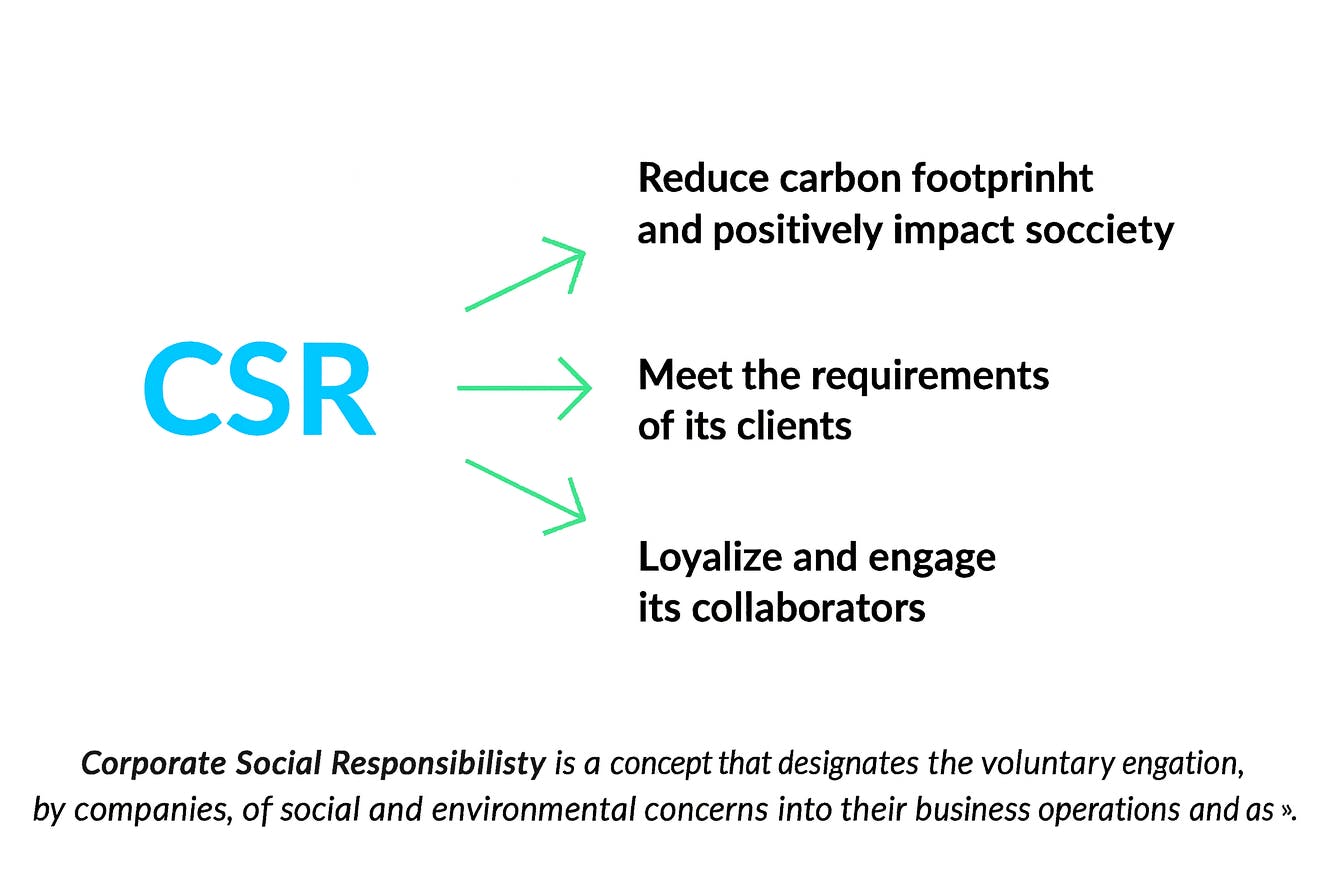
However, CSR implementation is often poorly managed:
- 6 in 10 employees say they are not involved in their company’s CSR strategy,
- 1 in 3 don’t know if their company has a CSR department,
- 25% of executives (including board members) have little or no understanding of CSR.
Training is a powerful lever to address these gaps. CSR training equips employees with the knowledge and skills needed to act, and 44% of employees say they want more training on climate and environmental issues.
So, how can you design a CSR training program that’s both relevant and engaging?
From awareness to action: building your CSR training strategy
The three phases of success: raise awareness, train, act
Like any learning process, employees first need to understand in order to take action. Effective CSR strategies rely on these three steps:
- Raise awareness: Help employees understand your company’s impact, and more broadly, global sustainability challenges.
- Train: Provide the skills and knowledge they need to take action, tailored to their roles and objectives.
- Act: Put knowledge into practice with an actionable plan and measurable outcomes.
This three-step process ensures employees are not only informed but also empowered and engaged—creating a win-win dynamic where collective efforts accelerate CSR goals.
To be effective, your CSR training should combine:
- Core content: common knowledge for all employees,
- Tailored modules: sector-specific or role-specific content.
Short, modular training sessions often work better than long, one-off programs. And of course, digital learning makes it easier to reach everyone, anywhere, anytime.
Adaptive Learning: personalizing CSR training
For maximum impact, integrate Adaptive Learning technology. This approach customizes training paths in real time, based on learner interactions, knowledge levels, and needs.
- Micro Adaptive Learning: Personalization at the module level.
- Macro Adaptive Learning: Personalization across an entire program, often beginning with a self-assessment that determines which modules are relevant.
The result: every employee gains awareness of sustainability issues, understands your company’s CSR strategy, and shares a common language for action.
Alongside digital modules, schedule live sessions to build engagement and momentum:
- Workshops to co-create CSR action plans,
- Conferences and talks on sustainability topics,
- Role-specific sessions for impacted teams,
- Festive moments to celebrate and recognize progress.
By combining digital training, adaptive learning, and collective engagement, companies can create a CSR training strategy that truly transforms, one that aligns employee expectations with corporate goals, and turns sustainability from a policy into a daily practice.
Want to know more about Teach Up?
Book a meeting with one of our experts