
Facilitating memory in digital learning with “chunking”

"There’s too much information, I’ll never be able to remember it all."
Memory plays a central role in the success of any training program. While we don’t all have the same memory capacity, there are proven strategies to help learners retain knowledge and acquire new skills in digital learning environments.
One of the most effective is a method called chunking. But before we dive into it, let’s quickly revisit how memory works.
How does memory work?
Our brain has a fine-tuned process for storing only the information we really need. This process unfolds in three phases:
- Encoding: translating information so it becomes meaningful
- Storage and consolidation: saving it in the right place for easy retrieval
- Retrieval: practicing recall so the information is available when needed
Two types of memory support this process:
- Short-term (working) memory: retains only a small amount of information for immediate use.
- Long-term memory: stores relevant knowledge for the future.
Attention acts as a filter, deciding which information is worth keeping. (We explore this further in our dedicated article on attention.)
Mnemonics can help, but chunking goes a step further.
Chunking: breaking information down to remember more
Chunking is the art of grouping information into smaller “chunks” to make it easier to remember. By creating clusters of information, you reduce the overall load on memory.
The concept was introduced in 1956 by psychologist George Miller, who suggested that our working memory can process about seven chunks at a time. The technique has been widely used by expert chess players, athletes, and now, instructional designers.
Example: remembering the first 10 digits of Pi
Instead of memorizing 3.1415926535 as a long sequence, you can group it:
- Already known: 3.14
- Remaining sequence: 15926535 → split into 159 – 26 – 53 – 5
Then add meaningful associations:
- 159 = Alfa Romeo 159
- 26 = number of letters in the alphabet
- 53 = French department Mayenne
- 5 = number of chunks you created
This transforms a random sequence into a memorable story, making recall much easier.
And the same principle applies to learning concepts in training.
How to apply chunking in digital training
To make chunking effective, two rules are key:
- Create connections between chunks: use stories, images, or metaphors.
- Reactivate chunks over time: practice retrieval to strengthen memory.
Here are 4 practical ways to integrate chunking into your digital training design:
1. Structure your content clearly
In a virtual class or e-learning module, focus on one concept per section. The clearer the structure, the easier it is for the brain to sort and retain information.
Example: a module with 3 sections, each with one key takeaway and a recap memo at the end.
2. Generate chunks with participants
Group discussions are powerful for helping learners create shared representations.
Example: ask learners to identify key ideas together and link them to familiar concepts.
3. Create mental associations
Learners remember better when they can connect new knowledge to past experiences. Storytelling, imagery, or even emojis can strengthen these associations.
Example: pair each keyword with an image, color, or emoji, and reuse it often.
4. End with a learner-created deliverable
Producing something concrete reinforces memory and supports collective intelligence.
Example: ask learners to design an infographic, memo sheet, or sketchnote that summarizes the key concepts.
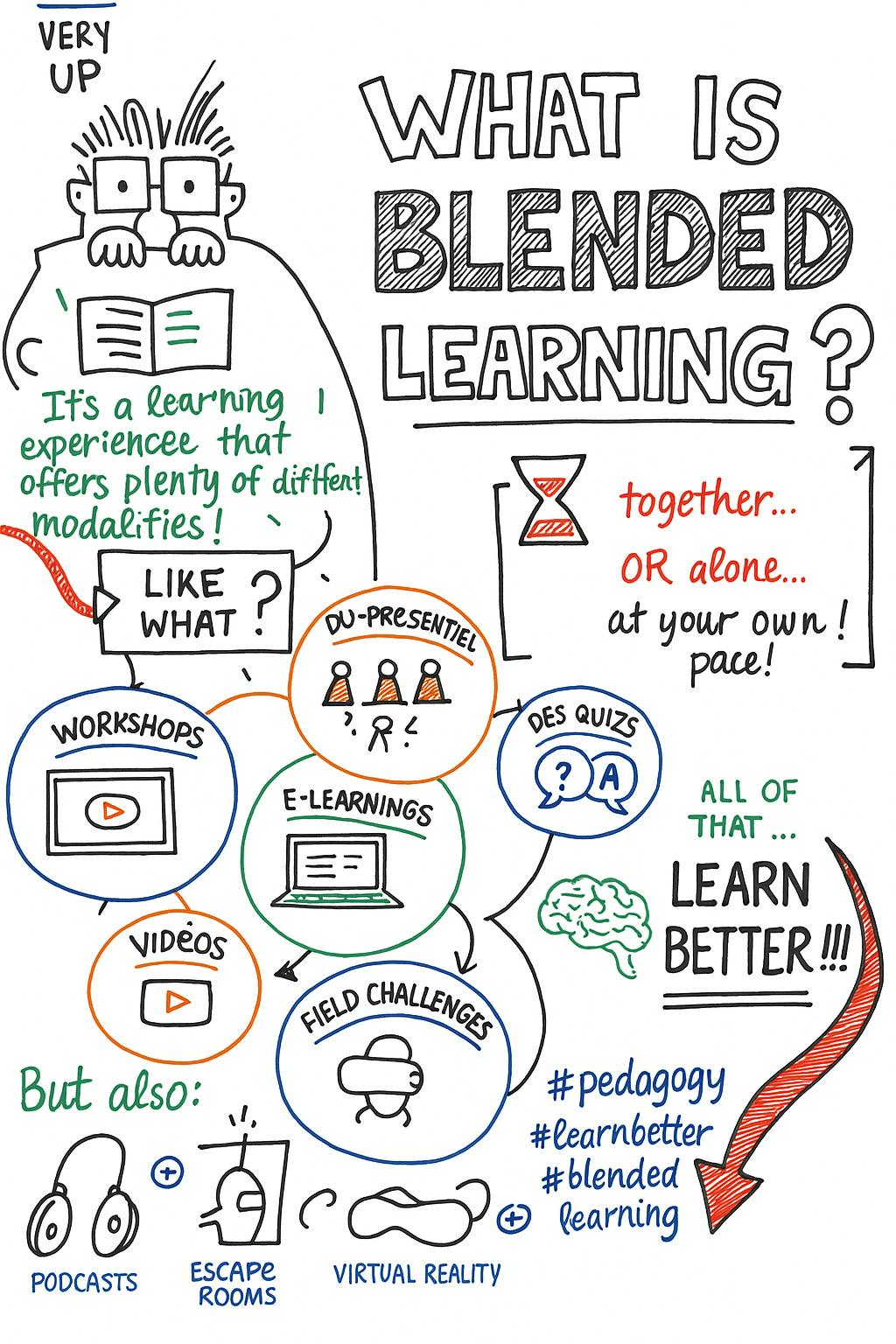
Chunking is a simple but powerful way to enhance memory in digital learning. By breaking down information, creating associations, and encouraging learners to reactivate knowledge, you can help them retain more and apply it with confidence.
You now have everything you need to adopt chunking in your digital training strategy!
Want to know more about Teach Up?
Book a meeting with one of our experts