
Assessing learners: how to choose the right format?

Today, no training program is complete without some form of assessment. In the data-driven world of L&D, evaluations provide trainers with a goldmine of insights.
But how do you choose the right format—without making the learning journey feel heavier or discouraging for participants? What are the main purposes of formative assessments?
Here are Teach Up’s best practices to help you design assessments that add value for both learners and trainers.
Identify your need
Before choosing the right assessment format, it’s essential to clarify what you want to achieve. One way to do this is to imagine a scale from 1 to 4, with 4 representing the most advanced type of evaluation.
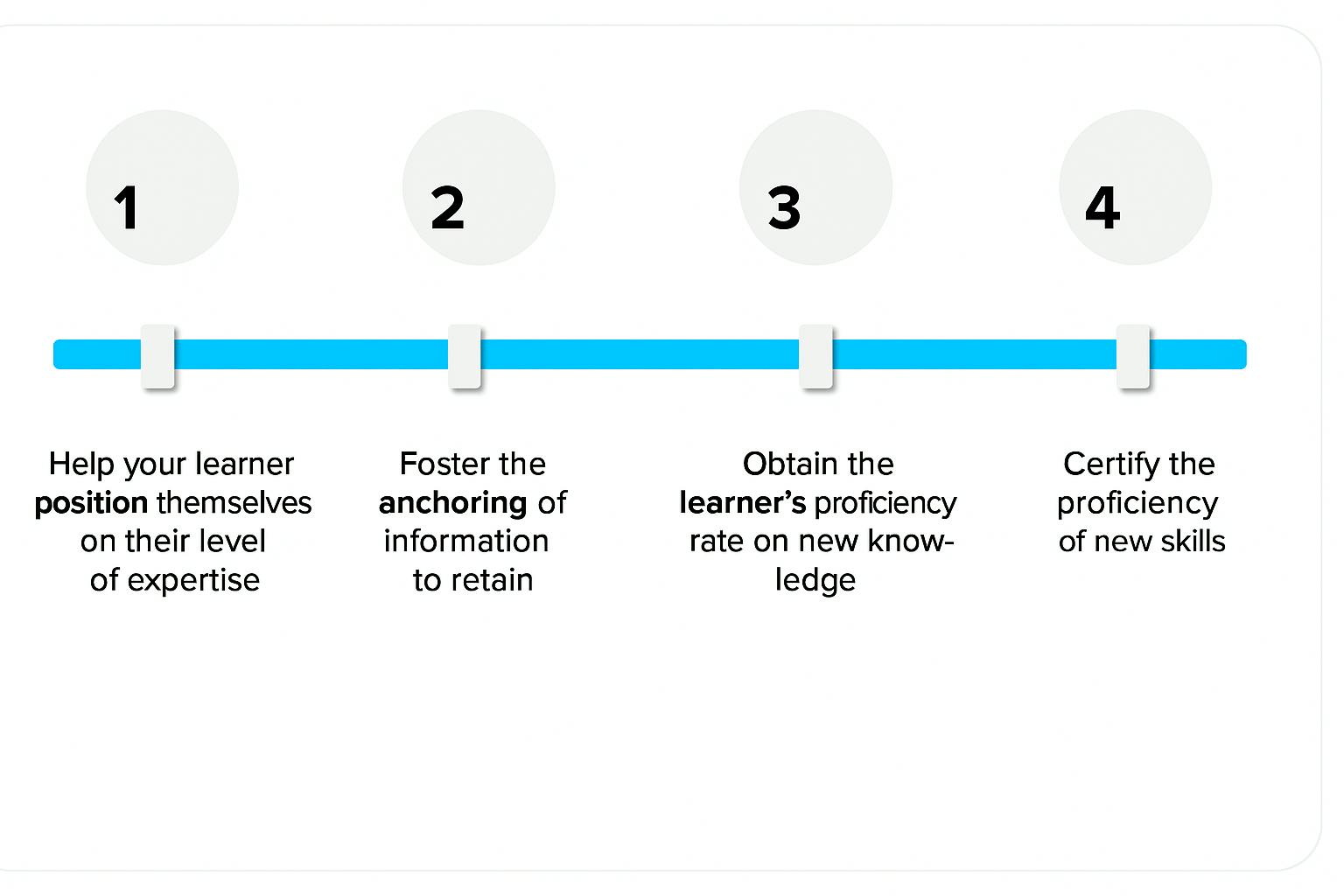
1. Positioning learners on their current knowledge
For learners: a diagnostic evaluation at the start of a program helps identify their baseline knowledge. It also gives them a way to track their own progress over time.
For trainers: collecting this data early allows you to tailor content and resources to learners’ actual needs.
2. Reinforcing key knowledge
For learners: short evaluations help reactivate memory and strengthen retention. These can happen:
- Immediately after training (hot evaluation) to highlight key takeaways.
- Days or weeks later (cold evaluation) to test long-term recall.
For trainers: success rates provide insights into where concepts are sticking, or where they need reinforcement.
3. Measuring mastery of new knowledge
For learners: post-training evaluations let them see exactly which concepts they’ve mastered and where they still need practice.
For trainers: this data reveals whether training has delivered tangible value and improved skills. Tools like Elevo’s TMS even allow follow-up evaluations months later to measure long-term impact.
4. Certifying new skills
For learners: certification is a strong motivator and adds professional recognition of their achievements.
For trainers: certifications validate the quality of a program, showcase success rates, and enhance your training brand.
Explore different formats
1. Learning games
Games make assessment fun while reinforcing knowledge. Formats such as word placement, open questions, matching, or label-switching can keep learners engaged as they revisit key concepts.
Platforms like Teach Up let you create gamified pathways where recurring questions are integrated directly into the module, turning evaluation into an engaging learning activity.
2. Quizzes and multiple-choice tests
The classic approach—still very effective for formal knowledge checks. MCQs keep the focus on content accuracy rather than playful design. Ideal for measuring understanding of core concepts.
3. Certifications
Certifications can take several forms: a cumulative score across module assessments, a final validated test, or even a cold evaluation weeks after training. The key is aligning the certification with your program’s goals.
Choose the right tool
Several tools can support different evaluation strategies, each with its strengths and limits.
Typeform
- Pros: user-friendly, great for creating quick surveys or questionnaires.
- Cons: lacks adaptive branching unless built manually, which can be time-consuming.
Kahoot
- Pros: fun, competitive, and highly engaging in group settings.
- Cons: more suited to energizing participants than to measuring skill mastery.
Teach Up
- Pros: combines adaptive learning with a wide variety of assessment formats. Create personalized evaluations that adapt to each learner’s level and ensure real skill mastery. Offers both gamified activities and traditional quizzes to track progress or certify achievement.
Want to know more about Teach Up?
Book a meeting with one of our experts